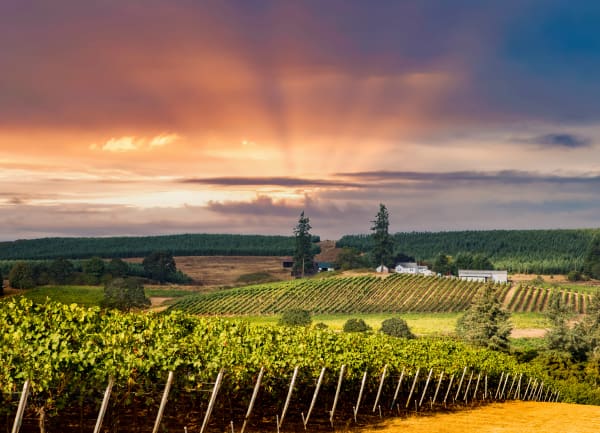
If you have only lent on farmland in Iowa, Kansas, or the Dakotas, agricultural lending in Oregon and California will feel like a different discipline. The bones are the same — collateral valuation, debt service capacity, borrower experience — but the regulatory overlay is dramatically more complex. Oregon has some of the strictest farmland preservation laws in the nation and a water rights system that can make or break a property's value. California has a water crisis that is reshaping agricultural economics in real time, a groundwater sustainability act that could reduce pumping rights by 20%–40% in some basins by 2040, property tax reassessment rules that create hidden cost events on transfer, and an ag economy dominated by high-value specialty crops whose pricing volatility exceeds anything in conventional row crop lending. Both states have strong farmland preservation movements, significant foreign and institutional investor activity that inflates land values, and specialty property appraisal requirements that narrow the pool of qualified appraisers to a handful of names. None of this makes ag lending in Oregon or California impossible. But it makes it different — and the lenders, appraisers, and advisors who navigate these markets successfully are the ones who understand the specific regulatory and economic factors that shape every deal. This article walks through the major complexities, state by state, and explains what they mean for borrowers seeking agricultural financing in the Pacific states.
Oregon: Water Rights Under Prior Appropriation
Oregon operates under a strict prior appropriation water rights system — commonly summarized as 'first in time, first in right.' Water rights in Oregon are real property rights that are appurtenant to the land, meaning they transfer with the property when it sells. But the transfer is not always clean, and the verification process can be one of the most time-consuming and consequential steps in an agricultural loan underwriting. Every water right in Oregon has a priority date. Senior rights — those established earliest — are the last to be curtailed during drought. Junior rights are the first to be shut off. In a basin where water is fully allocated, the difference between a 1910 priority date and a 1975 priority date can be the difference between a fully irrigated operation and a dryland farm during a dry year. For a lender, this distinction directly affects collateral value. A 500-acre farm with senior water rights and a reliable irrigation supply is fundamentally different collateral than the same 500 acres with junior rights that may be curtailed in three out of every ten years. The Oregon Water Resources Department (OWRD) maintains records of all certificated water rights, but the records are not always straightforward. Some rights have been partially forfeited due to non-use (Oregon applies a 'use it or lose it' standard — five consecutive years of non-use creates a presumption of forfeiture). Some rights have been transferred between points of diversion or places of use, and the chain of transfers may not be fully documented. Some rights are subject to instream water right claims, tribal trust obligations, or adjudication proceedings that cloud the title. Before closing an agricultural loan in Oregon, the lender — or the lender's counsel — needs to verify the water right certificate number, the priority date, the authorized quantity (in cubic feet per second or acre-feet per year), the authorized place of use and point of diversion, and whether any forfeiture, cancellation, or transfer proceedings are pending. If the property relies on groundwater rather than surface water, the lender also needs to confirm that the well is properly permitted and that the groundwater basin is not subject to critical area designation, which can restrict new appropriations or reduce existing pumping allocations. This verification is not optional. A farm appraised at $8,000 per acre with full, senior water rights may be worth $3,000 per acre without them. That is not a marginal adjustment — it is a collateral value reduction that can make the difference between a viable loan and a decline.
Oregon: Measure 49 and Exclusive Farm Use Zoning
Oregon's land use system is built on a framework that dates to the 1970s — Senate Bill 100, the statewide land use planning act — and it is arguably the most restrictive farmland preservation regime in the United States. The system's central mechanism is Exclusive Farm Use (EFU) zoning. Land zoned EFU is restricted to agricultural use and a narrow set of farm-related activities. You cannot subdivide it for residential development. You cannot rezone it for commercial or industrial use without an exception process that is difficult, expensive, and rarely granted. You cannot build a second dwelling on it unless it qualifies as a farm worker housing unit or a relative's necessary dwelling under strict criteria. For agricultural borrowers, EFU zoning is a feature — it preserves the agricultural character of the land, prevents encroachment by non-farm development, and maintains the land's productive value over time. For agricultural lenders, EFU zoning is both a feature and a constraint. The feature is stability: EFU land is not going to be rezoned into a subdivision that undermines adjacent agricultural values. The constraint is exit strategy: if the borrower defaults and the lender takes the property through foreclosure, the lender's disposition options are limited to selling the property as agricultural land to another agricultural buyer. There is no development premium. There is no highest-and-best-use analysis that imagines future residential lots. The collateral is worth what it is worth as a farm — and the lender's recovery is capped at that value. Measure 49, passed by Oregon voters in 2007, further refined and restricted the exceptions to EFU zoning that had been created by the earlier (and more permissive) Measure 37. The net effect is that Oregon's farmland preservation system is robust, well-enforced, and not going away. Ag lenders operating in Oregon need to underwrite with the understanding that EFU land is EFU land — period — and that the collateral value is determined by its agricultural productivity, water rights, soil quality, and comparable farm sales, not by speculative development potential.
California: Water Is the Defining Issue
If there is a single sentence that captures the difference between ag lending in California and ag lending everywhere else, it is this: in California, you are not lending on the land — you are lending on the water. California's water system is one of the most complex legal and physical infrastructures in the world. Surface water is allocated through a combination of riparian rights (tied to land adjacent to a watercourse), appropriative rights (similar to Oregon's prior appropriation system), and contractual rights through federal and state water projects — the Central Valley Project, the State Water Project, and dozens of local irrigation districts. A farm's water supply may come from one or several of these sources, and the reliability of that supply varies enormously depending on the right type, the priority date, the district's allocation formula, and the prevailing hydrological conditions. In a wet year, most rights holders receive full allocations. In a drought year — and California has experienced severe, multi-year droughts in 2007–2009, 2012–2016, and 2020–2022 — junior rights holders may receive zero allocation while senior rights holders receive 75% or less of their historical entitlement. For permanent crops like almonds, pistachios, and wine grapes — which represent hundreds of billions of dollars of installed value across the Central Valley and Coast Ranges — a water curtailment is not just an inconvenience. It is an existential threat. A mature almond orchard that costs $20,000–$30,000 per acre to establish and requires 3.5–4.0 acre-feet of water per year cannot survive a season without irrigation. If the water allocation drops to zero, the trees die. The investment is lost. The collateral is destroyed. This is why water rights verification in California is even more consequential than in Oregon, and why ag lenders who are serious about California lending maintain in-house expertise or engaged consultants who can evaluate the reliability, priority, and transferability of every water right attached to a property they are considering as collateral.
California: SGMA and the Groundwater Reckoning
The Sustainable Groundwater Management Act (SGMA), signed into law in 2014, is the single most significant regulatory development in California agricultural water management in decades — and its implications for ag lending are only beginning to be fully understood. SGMA requires all high- and medium-priority groundwater basins in California to achieve sustainability by 2040 (2042 for medium-priority basins). Sustainability is defined as eliminating conditions of chronic lowering of groundwater levels, significant and unreasonable reduction of groundwater storage, significant and unreasonable seawater intrusion, significant and unreasonable degraded water quality, significant and unreasonable land subsidence, and depletions of interconnected surface water. Each basin is managed by a Groundwater Sustainability Agency (GSA) that has prepared a Groundwater Sustainability Plan (GSP) specifying how sustainability will be achieved. In practice, for many overdrafted basins in the San Joaquin Valley and other parts of the Central Valley, achieving sustainability means reducing total groundwater pumping — in some basins by 20% to 40% or more. For individual farm operations, this means their historical pumping may be curtailed. Land that has been irrigated for decades using groundwater may lose a portion of its irrigation capacity permanently. The economic impact is straightforward: less water means fewer irrigable acres, lower crop yields, and reduced land value. Some estimates suggest that 500,000 to 1,000,000 acres of currently irrigated farmland in California may need to be fallowed or converted to dryland agriculture as SGMA implementation progresses — a transformation that directly affects collateral values for agricultural lenders. For a lender evaluating a loan on irrigated Central Valley farmland, SGMA introduces a new underwriting dimension that did not exist before 2014. The lender needs to understand which GSA governs the property, what the GSP specifies for pumping allocations in that basin, whether the property's current pumping is likely to be curtailed, and by how much. A farm appraised today at $15,000 per acre based on full irrigation may be worth $5,000–$8,000 per acre if SGMA implementation reduces its water allocation by 30%. That is not a hypothetical risk — it is a regulatory certainty that is playing out basin by basin across the state.
California: Proposition 13 and the Reassessment Trap
Proposition 13, passed by California voters in 1978, limits property tax assessments to 1% of the purchase price at the time of acquisition, with annual increases capped at 2% regardless of market appreciation. For agricultural land that has been held by the same family for decades, Prop 13 creates an artificially low property tax base that can make the operation appear more profitable than it actually is on a market-adjusted basis. A Central Valley almond ranch purchased in 1985 for $2,000 per acre might have a current assessed value of $4,500 per acre under Prop 13's 2% annual cap — but a current market value of $25,000 per acre. The property taxes on that ranch reflect the $4,500 assessed value, not the $25,000 market value. When the property is sold or transferred (outside of certain parent-child exclusions that were significantly narrowed by Proposition 19 in 2020), the assessment resets to the purchase price. The new owner's annual property tax on that $25,000-per-acre ranch is five to six times what the previous owner was paying. For ag lenders, the Prop 13 dynamic matters in several contexts. First, when underwriting a purchase, the lender must project the borrower's property tax obligation based on the purchase price, not the seller's historical tax bill. Many agricultural cash flow projections presented to lenders are based on the seller's operating history, which includes the seller's artificially low Prop 13 tax base. The buyer's actual operating costs will be significantly higher. Second, when evaluating entity restructuring — a common scenario when family operations transition between generations or when investors bring in partners — the lender needs to assess whether the proposed transaction triggers a reassessment. Certain transfers between family members, into and out of trusts, or between entities may or may not trigger reassessment depending on the specifics of the transaction and the applicable exclusions. Getting this analysis wrong can add six figures per year to a property's operating costs — enough to turn a cash-flowing operation into a negative-cash-flow liability.
California: Specialty Crop Volatility and Commodity Price Risk
California's agricultural economy is fundamentally different from the Midwest and Great Plains. While Iowa, Kansas, and Nebraska are dominated by row crops — corn, soybeans, wheat — whose prices are transparent, hedgeable, and relatively stable year to year, California is dominated by high-value specialty crops whose pricing is more volatile, less transparent, and harder to hedge. Almonds, pistachios, walnuts, wine grapes, strawberries, lettuce, tomatoes, avocados, citrus — these crops command higher per-acre revenue than row crops, but they also carry higher production costs, more complex labor requirements, and pricing that can swing dramatically based on global supply conditions, trade policy, consumer preferences, and weather events in competing production regions. Almonds are a useful illustration. California produces approximately 80% of the world's almond supply. Almond prices hit $4.00 per pound in 2014, collapsed to $1.20 per pound in 2022, and have partially recovered since. A 1,000-acre almond operation that was generating $4 million in annual gross revenue at $4.00 per pound was generating $1.2 million at $1.20 per pound — a 70% decline in revenue with no meaningful reduction in operating costs. That kind of volatility is outside the normal range for row crop underwriting. For ag lenders, specialty crop financing requires commodity price risk analysis that goes beyond looking at the current year's price and projecting it forward. The lender needs to understand the crop's supply and demand dynamics, the borrower's cost of production relative to current and projected pricing, whether the borrower has contracted a portion of the crop at a fixed price, and what the break-even price per unit is after accounting for all operating, capital, and debt service costs. Lenders also need to be aware that specialty crop operations are typically more capital-intensive than row crops. A mature almond orchard requires $20,000–$30,000 per acre in cumulative investment from planting to full production (year 5–6). A vineyard establishment can cost $30,000–$50,000 per acre or more depending on the varietal, trellising system, and irrigation infrastructure. If prices decline below the cost of production for an extended period, the borrower cannot simply plant a different crop next season — the investment is sunk in trees or vines that take years to establish and cannot be economically replaced.
California: Environmental and Labor Regulations
California's regulatory environment for agriculture is the most extensive and most expensive in the nation. Pesticide regulation, air quality standards, water discharge requirements, endangered species protections, and labor laws all add layers of operational cost and compliance risk that do not exist — or exist in much milder form — in other agricultural states. The California Department of Pesticide Regulation (DPR) restricts or bans pesticides that are approved for use in other states. The Regional Water Quality Control Boards impose irrigated lands regulatory programs that require farmers to monitor and report water quality from agricultural runoff. The California Air Resources Board (CARB) regulates agricultural burning, diesel equipment emissions, and dust from farming operations. The Endangered Species Act — both federal and California state versions — can restrict farming activities near critical habitat, impose buffer zones, and require biological assessments before land clearing or development. California's labor laws are the most protective in the nation for agricultural workers: overtime requirements, heat illness prevention standards, minimum wage increases, and restrictions on piece-rate compensation all increase the cost of labor-intensive crops like strawberries, lettuce, and citrus. For ag lenders, these regulatory costs are part of the underwriting. A cash flow projection that does not account for compliance costs — monitoring, reporting, equipment upgrades, labor law adherence, legal fees associated with regulatory interactions — will overstate the borrower's net operating income and understate the true cost of operations. In extreme cases, regulatory non-compliance can result in fines, cease-and-desist orders, or restrictions on water use that directly impair the property's productive capacity and, by extension, the lender's collateral value.
Common to Both States: Farmland Preservation and Investor Activity
Oregon and California share two structural characteristics that distinguish their agricultural land markets from the rest of the country. First, both states have strong farmland preservation frameworks — Oregon through its EFU zoning system and statewide land use planning, California through the Williamson Act (which provides property tax reductions for land committed to agricultural use for a minimum of 10–20 years) and local agricultural preservation ordinances. These frameworks limit the conversion of farmland to other uses, which stabilizes agricultural land values over time but also caps the upside for lenders who might otherwise rely on development potential as a secondary source of collateral value. Second, both states have experienced significant inflows of foreign and institutional investment capital into agricultural land over the past two decades. Pension funds, endowments, family offices, and sovereign wealth funds have all been active buyers of Oregon and California farmland — attracted by the combination of strong crop revenue, water rights value, and long-term inflation hedging characteristics. This institutional activity has inflated land values in some markets beyond what traditional cap rate-based appraisals would support. A Central Valley almond ranch that generates a 4% cash-on-cash return at its current purchase price is trading on appreciation expectations and water rights value, not on current income. For ag lenders, this creates an appraisal challenge: the comparable sales reflect institutional pricing, but the borrower's debt service capacity reflects farm-level cash flow. When institutional capital retreats — as it does periodically during commodity downturns — the comparable sales disappear and values can correct sharply. Lenders need to underwrite through the cycle, not at the peak.
Specialty Property Appraisals and Farmer Mac Requirements
Both Oregon and California have agricultural property types that require specialized appraisal expertise — vineyards, orchards, timber, dairies, ranches with complex water systems, irrigated row crop operations with sophisticated infrastructure. A general-purpose real estate appraiser — even one with a rural residential specialty — is typically not qualified to appraise a 2,000-acre irrigated almond operation in the Central Valley or a 500-acre grass seed farm with senior water rights in the Willamette Valley. Farmer Mac — the Federal Agricultural Mortgage Corporation — is the secondary market for agricultural real estate loans, analogous to Fannie Mae and Freddie Mac in the residential space. Farmer Mac purchases and guarantees agricultural mortgage loans from approved lenders, providing liquidity and enabling competitive rates for agricultural borrowers. But Farmer Mac is particular about appraisals. The appraiser must have demonstrated competency in the specific property type and geographic area. For specialty crops (orchards, vineyards, permanent plantings), the appraiser must understand crop economics, irrigation systems, and the relationship between water rights and land value. For ranch properties, the appraiser must understand carrying capacity, grazing permits, and the distinction between deeded land and leased public land. In Oregon and California, the pool of appraisers who meet these requirements for specific property types is small — sometimes fewer than a dozen names for a given crop type and geography. This creates practical challenges: appraisal turnaround times are longer (4–6 weeks is common for complex agricultural properties), costs are higher ($5,000–$15,000+ for large or complex operations), and scheduling conflicts can delay closings. For borrowers, the lesson is to start the appraisal process early — before you are under contract pressure — and to work with a lender who already has relationships with qualified agricultural appraisers in your area. For lenders, the lesson is that the appraisal is not a commodity on these deals. The quality and expertise of the appraiser directly affects the reliability of the collateral valuation and, by extension, the soundness of the loan.
What This Means for Ag Borrowers in Oregon and California
None of the complexities described in this article are insurmountable. Thousands of agricultural loans close every year in Oregon and California, on every property type from dryland wheat ground to irrigated permanent crops to diversified ranch operations. But the borrowers and lenders who navigate these markets successfully share a few characteristics. They verify water rights early and thoroughly. In Oregon, this means confirming the certificate number, priority date, and use status with OWRD. In California, this means understanding the source (surface, groundwater, or contractual), the priority, the reliability under drought conditions, and the SGMA implications for groundwater-dependent properties. They understand the land use framework. In Oregon, this means accepting — and pricing — the EFU zoning restrictions that limit development alternatives. In California, this means understanding Williamson Act contracts, Prop 13 reassessment triggers, and local agricultural preservation ordinances. They account for the full cost of operations. In California especially, this means including regulatory compliance costs, labor law costs, and environmental monitoring in the cash flow projection — not just the obvious line items of seed, fertilizer, and equipment. They work with specialized appraisers. For any property involving permanent crops, water rights, or complex agricultural infrastructure, a general appraiser is not sufficient. The lender and the borrower both benefit from an appraiser who understands the specific crop, the specific water system, and the specific market. And they work with lenders who understand agricultural lending in these specific states. A lender who is accustomed to underwriting 1,000-acre corn farms in Illinois may not have the expertise to evaluate a 200-acre vineyard in the Rogue Valley with senior water rights and EFU zoning — or a 3,000-acre almond operation in the San Joaquin Valley with junior surface water rights, a SGMA-governed groundwater basin, and a Prop 13 reassessment event on the horizon.
The Lumen Mortgage Approach to Agricultural Lending
Agricultural lending is not a sideline for Lumen Mortgage. We finance farm and ranch properties across Oregon and California through Farmer Mac-approved programs, offering fixed-rate terms up to 30 years, loan amounts from $250,000 to over $10 million, and structures that include term loans, equity lines of credit, and refinance options designed for agricultural borrowers with agricultural cash flow patterns. We understand the water rights verification process in both states. We understand EFU zoning in Oregon and the Williamson Act in California. We understand SGMA and its implications for groundwater-dependent properties. We understand specialty crop underwriting, commodity price risk, and the appraisal requirements for permanent plantings, vineyards, and complex agricultural operations. And we understand that agricultural borrowers are not residential borrowers with more acreage. Farm and ranch families operate in a different economic environment, with different cash flow timing, different risk profiles, and different long-term objectives. The financing should reflect all of those differences. If you own or are purchasing agricultural property in Oregon or California — whether it is irrigated cropland, rangeland, an orchard, a vineyard, a dairy, or a diversified operation — call us at 503-966-9255 or email info@lumenmortgage.com. We will evaluate the property, assess the water rights, model the cash flow, and show you every financing option available. No pressure. No generic advice. Just a lender who understands your land, your operation, and the regulatory landscape you operate in.
Model Your Farm Loan
Agricultural Loan Calculator
Agricultural loans work differently from residential mortgages — larger required down payments, sometimes shorter amortization periods, and monthly carrying costs that need to work against seasonal income rather than a steady paycheck. Before you make an offer on farmland or a rural property, knowing your payment scenario shapes the entire negotiation.
The ag loan calculator lets you model purchase price against the 25–35% down payments typical of farm lending, compare 20-, 25-, and 30-year amortization schedules, and see how rate variations move your monthly carrying cost. For a cash-flowing operation, that monthly number is as important as the land price itself.
Down payment scenarios
Model your monthly payment at 25%, 30%, and 35% down — the range most ag lenders require on farm purchases.
Amortization comparison
See how 20-yr vs. 25-yr vs. 30-yr amortization changes your monthly payment and total interest paid over time.
Rate sensitivity
Small rate differences compound significantly over long amortizations on large balances. See the real magnitude.
Free · No login · No credit pull required
Realtor Referral
Need a realtor who sells working farms — not just rural homes?
Most rural-listing agents treat ag land like residential acreage with a barn. The buyers who close cleanly use agents who understand water rights, zoning overlays, ag exemptions, and which lenders will actually fund the deal. We work with ag specialists across the Willamette Valley, Southern Oregon, the Sacramento Valley, and the Sierra Foothills — happy to introduce you to one who fits your target market.
No directory. No paid placements. No RESPA-restricted referral fees. We've worked alongside these pros on real Oregon and California deals — we'll make a personal email introduction so you can interview them yourself.
Or email us directly:
How is agricultural lending different in Oregon vs. California?
Oregon and California are two of the most productive — and most complicated — agricultural lending states in the country. Oregon's strict EFU zoning and prior appropriation water rights create unique collateral constraints, while California's SGMA groundwater curtailments, Prop 13 reassessment traps, and specialty crop volatility introduce underwriting dimensions that don't exist in conventional ag lending markets. Both states require specialized appraisers, water rights verification, and lenders who understand these regulatory layers.
Best for: Farm and ranch borrowers purchasing, refinancing, or restructuring agricultural property in Oregon or California who need a lender that understands the state-specific regulatory complexity.
Oregon vs. California: Key Agricultural Lending Differences
Regulatory and underwriting factors that shape every ag loan in these states
| Oregon | California | |
|---|---|---|
| Water Rights System | Prior appropriation (first in time, first in right) | Mixed: riparian, appropriative, and contractual rights |
| Groundwater Regulation | OWRD permits; critical area designations | SGMA: mandatory sustainability by 2040; 20–40% pumping cuts |
| Farmland Zoning | EFU — strictest in U.S.; no subdivision/rezoning | Williamson Act voluntary contracts; local ordinances |
| Property Tax on Transfer | Standard reassessment at sale | Prop 13: taxes can increase 5–6x on transfer |
| Dominant Crops | Grass seed, hazelnuts, wine grapes, timber, cattle | Almonds, pistachios, wine grapes, berries, citrus |
| Crop Price Volatility | Moderate (diversified, smaller scale) | High (specialty crops, global supply sensitivity) |
| Regulatory Compliance Cost | Moderate | High (DPR, CARB, RWQCB, ESA, labor laws) |
| Appraisal Complexity | High (water rights, EFU, timber) | Very high (permanent crops, SGMA, Prop 13) |
2040
SGMA Deadline
500K–1M
Fallowed Acres (CA)
20–40%
Pumping Cuts
5–6x
Prop 13 Tax Jump
−70%
Almond Price Swing
$5K–$15K+
Appraisal Cost
4–6 weeks
Appraisal Time
$3K–$8K/acre
Water Right Swing
Looking for Ag Financing?
Farm purchase, ranch, raw land, operating lines, and specialty crop loans — structured around how your operation actually works.
Bottom Line
Oregon and California are extraordinary agricultural states — productive, diverse, and valuable. They are also extraordinarily complex lending environments. Water rights, land use restrictions, groundwater sustainability mandates, property tax reassessment rules, specialty crop volatility, and regulatory compliance costs all create underwriting layers that simply do not exist in conventional agricultural lending markets. The borrowers and lenders who succeed in these states are the ones who understand the complexity, account for it in their analysis, and structure financing that reflects the specific risks and opportunities of each property. That is what we do at Lumen Mortgage — and it is why agricultural borrowers in Oregon and California trust us to get these deals right. Run your scenario through our free Oregon farm loan calculator to see monthly payments at any down-payment and amortization combination before you call.