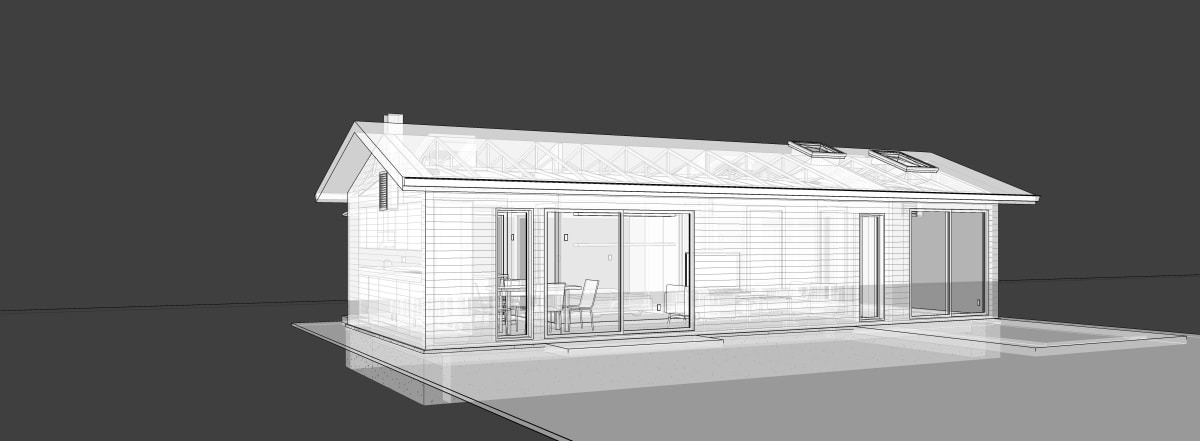
How do you finance an ADU in Oregon under the Middle Housing Land Division law?
Oregon's Middle Housing Land Division (MHLD) law lets owners split lots containing duplexes, triplexes, quadplexes, cottage clusters, and ADUs into separately owned parcels — which changes how these units can be financed. For a new accessory dwelling unit, your options generally include construction financing (renovation or construction loans) to build it, and DSCR loans to finance or refinance the property based on the rental income it generates rather than your personal income. How an ADU is classified — attached vs. detached, and whether the lot is split — drives which program and appraisal approach apply.
Best for: Oregon property owners and investors building or refinancing ADUs who want to use rental-income (DSCR) qualifying or take advantage of MHLD lot splits.
Oregon has quietly built one of the most progressive middle housing and ADU policy environments in the country -- and most property owners have not fully understood what that means for their finances. The Middle Housing Land Division (MHLD) law, which took effect for Oregon's largest cities in 2022 and expanded statewide through 2023, did not just allow more housing types. It changed the ownership structure of middle housing entirely -- enabling lots containing duplexes, triplexes, quadplexes, cottage clusters, and ADUs to be divided and sold as separate legal parcels, much like condominiums. For homeowners, investors, and developers who understand the financing implications, this is one of the most significant shifts in Oregon real estate in a generation. Here is a ground-level look at what the law actually does, how ADU financing works in 2026, and why the DSCR loan is the workhorse product for investors entering this space.
What Oregon's Middle Housing Land Division Law Actually Does
To understand the financing implications, you need to understand what changed. Before MHLD, if you built a duplex or detached ADU on a single-family lot in Oregon, the entire property -- both units -- was owned under one title and financed with one mortgage. You could not sell the ADU separately. You could not give a buyer their own deed to the detached cottage in the backyard. The two units were legally inseparable. Oregon Senate Bill 458 (2021), which created the MHLD process, changed that. Under MHLD, a property owner who has constructed middle housing -- defined in Oregon law to include duplexes, triplexes, quadplexes, cottage clusters, townhouses, and in some jurisdictions detached ADUs -- can apply for a middle housing land division that creates individual lots for each unit. Each resulting parcel gets its own legal description, its own deed, its own title insurance, and -- critically -- its own mortgage. The process runs through local planning departments rather than the full subdivision approval process, and cities are required to approve MHLD applications that meet minimum standards. The practical effect: a property owner who builds a quality detached ADU on a conforming lot in Portland can now potentially sell the ADU on its own lot to a separate buyer, refinance each unit independently, or hold both as separately financed rental units with individual DSCR loans.
Oregon's Broader Middle Housing Context: How We Got Here
The MHLD law did not emerge from a vacuum. It is part of a deliberate legislative arc that began with Oregon House Bill 2001, signed into law in 2019, which required cities with populations over 10,000 to allow duplexes on all lots in residential zones -- by right, without discretionary review. Larger cities (25,000+) were required to also allow triplexes, quadplexes, cottage clusters, and townhomes. Portland had already been ahead of the curve on ADUs: since 2010, Portland has allowed detached ADUs in all residential zones, eliminated off-street parking requirements for ADUs, and at various points waived or capped system development charges to incentivize construction. What HB 2001 did statewide -- and what MHLD built on -- is eliminate the zoning exclusivity that had kept most Oregon residential neighborhoods locked into single-family-only development for decades. Today, if you own a standard lot in Salem, Eugene, Bend, Medford, or any Oregon city over 10,000, you can build a duplex on it by right. In many jurisdictions you can add an ADU on top of that. And under MHLD, you may be able to divide the resulting parcels into separately ownable units. The investment math that follows from these policy changes is significant -- and the lending market is catching up.
Types of ADUs and How They Are Classified for Financing
Not all ADUs are financed the same way, and the classification matters enormously for which loan programs are available. A detached ADU (DADU) is a fully separate structure on the same lot as a primary residence -- a standalone cottage, a converted garage, a purpose-built backyard unit. Before MHLD, a property with a primary home and a DADU was typically financed as a single-family home with an accessory structure; the DADU income was treated as rental income supplementing owner-occupied qualification. After an MHLD lot split, the DADU and primary home can each become their own parcel and be financed independently. An attached ADU shares a wall with the primary residence -- think a converted basement unit or a mother-in-law suite accessible from an interior door. These are typically treated as part of the primary structure for appraisal and financing purposes; the rental income from the attached unit counts in the primary owner's qualification, but the unit cannot be divided off and sold separately under MHLD. A junior ADU (JADU) is typically a small interior conversion within the primary home itself -- a single room or studio with its own exterior entrance. JADUs are treated as part of the primary residence for lending purposes and do not trigger 2-unit property classification. For investors -- as opposed to owner-occupants adding one unit -- the relevant product for a multi-unit property is typically a DSCR loan rather than a standard residential mortgage.
Financing a New ADU Construction: What Your Options Are
Building a detached ADU typically costs between $150,000 and $400,000 in Oregon depending on size, site conditions, materials, and the specific market. That is a meaningful capital outlay, and the financing path depends heavily on your existing equity and current mortgage situation. For homeowners with significant equity, a cash-out refinance or home equity line of credit (HELOC) on the primary residence is often the most straightforward path. If your home has appreciated substantially since purchase -- and most Oregon homeowners who bought before 2021 have seen significant appreciation -- you may be able to pull out the full construction cost in a single refinance or draw on a HELOC as construction progresses. For new purchases of properties already containing a DADU or an under-construction ADU, a conventional conforming loan is available on owner-occupied 1-4 unit properties, with the rental income from the ADU potentially counting toward qualification (typically using 75% of the market rent to offset the proposed PITI). For properties purchased specifically as investment rentals -- where neither unit will be owner-occupied -- a DSCR loan is almost always the most appropriate tool. The DSCR loan qualifies the property based on its gross rental income relative to the debt service, with no personal income documentation required. For an Oregon property with a primary unit and a fully rented ADU, the combined rent from both units is used to calculate the DSCR ratio.
DSCR Loans for ADU Properties: How the Math Works
The core DSCR calculation is straightforward: monthly gross rent divided by monthly PITI (principal, interest, taxes, insurance). A ratio of 1.0 means the rent exactly covers the mortgage payment. Most DSCR lenders want to see at least 1.0, with 1.25 or higher being a comfortable approval. For a two-unit property in Portland -- the primary house plus a DADU -- the gross rent calculation includes both units. Consider a realistic example: a primary house renting for $2,800 per month and a detached ADU renting for $1,600 per month on a property purchased for $750,000 with 25% down. The loan amount is $562,500. At a 7.25% rate on a 30-year term, the PITI (including estimated taxes and insurance) might run approximately $4,400 per month. Combined gross rent of $4,400 against a PITI of $4,400 produces a DSCR of exactly 1.0 -- qualifying at most DSCR lenders. A modest rent increase on either unit, or a slightly lower purchase price, pushes that ratio above 1.0 comfortably. This is why the ADU rent matters so disproportionately in DSCR math: on a single-family house with one rent stream, every dollar of rent moves your DSCR directly. Adding a second rent-generating unit -- even a small one -- can transform a deal that does not qualify into one that does. DSCR loans for 2-unit properties (how a house-plus-DADU is classified before an MHLD lot split) require a minimum 20% down payment and a 620+ credit score, and with 25% or more down they often price better than a conventional investment loan. Loans can close in an LLC or entity, which many Oregon investors prefer for liability management.
The MHLD Lot-Split Strategy: Before and After Financing
Here is where the MHLD law creates a genuinely new investment playbook that did not exist before 2022. Before lot split: you purchase a property containing a house and a quality DADU. You finance it as a 2-unit investment property using a DSCR loan. You collect rent from both units and build equity. After lot split: you apply to your city for an MHLD lot division. The process creates two separate legal parcels -- one containing the primary house, one containing the DADU. At this point your options multiply considerably. You could sell the DADU parcel independently to a separate buyer, effectively cashing out a portion of your investment while retaining the primary house. You could refinance each parcel separately with its own DSCR loan, potentially pulling cash out of each while keeping both as rentals. You could sell the primary house and retain the DADU as a standalone rental -- a small-footprint, low-maintenance investment property. You could owner-occupy the primary house (now on its own parcel) while renting the DADU, potentially converting the financing on the primary parcel to an owner-occupied conventional mortgage at a lower rate. The post-lot-split flexibility is the key advantage. Before MHLD, a property with a house and DADU was one asset with limited exit strategies. After MHLD, it potentially becomes two assets with independent ownership, financing, and sale options. Investors who understand this have a meaningful structural advantage over those who do not.
What Appraisers and Underwriters Look for on ADU Properties
Appraisal is often where ADU deals encounter friction, and understanding the dynamics helps you avoid the most common pitfalls. Comparable sales matter more than most buyers expect. Appraisers are required to use comparable sales of similar property types -- meaning a house-plus-DADU should be compared against other 2-unit sales where possible, or against single-family homes with verified ADU income where true 2-unit comps are not available. In markets where DADU construction is relatively new, the comparable sale base can be thin. In Portland, where the ADU stock is well-established and the market for DADU-equipped properties is mature, comparables are generally available and appraisers familiar with the product are not hard to find. Permitting status is scrutinized carefully by underwriters. An unpermitted ADU -- built without permits and absent from county records -- is generally treated as non-existent for income qualification purposes and can create significant lending problems. Always verify that an ADU is fully permitted before you go under contract; it is one of the first questions a DSCR underwriter will ask. For income documentation, DSCR underwriters typically require either a signed lease agreement reflecting actual rents or a 1007 Single-Family Comparable Rent Schedule completed by the appraiser to establish market rent. For 2-unit properties, the appraiser completes a 1025 Small Residential Income Property Appraisal Report. Knowing which forms apply prevents documentation surprises at the underwriting stage.
Portland's ADU Market in 2026: Conditions on the Ground
Portland remains the epicenter of Oregon's ADU market by volume and by policy maturity. As of 2026, Portland has one of the largest per-capita DADU stocks of any major U.S. city, with thousands of detached ADUs constructed since the 2010 policy reforms. The rental market for ADUs in Portland is strong and stable -- DADUs typically command $1,200 to $2,200 per month depending on size, finishes, and neighborhood, with inner Southeast Portland, Northeast, and the close-in Westside neighborhoods generating the highest rents. From an investment standpoint, the most compelling Portland ADU plays in 2026 are: purchasing existing properties that already have a quality DADU in place, providing immediate rental income without construction risk; developing a DADU on a property you already own, using equity financing and a DSCR refinance after construction is complete to recapitalize; and purchasing a property specifically targeted for an MHLD lot split, with a post-split sale strategy for one of the resulting parcels. Interest rates in the 7.25-7.75% range have compressed returns compared to the 2020-2021 era, but ADU rents have kept pace with general Portland rent growth and continue to support DSCR ratios that make deals workable for well-structured purchases.
Beyond Portland: ADU Opportunities Across Oregon
Portland gets the attention, but Oregon's middle housing and MHLD framework applies statewide, and the investment dynamics are compelling in several other markets. Bend has experienced extraordinary price appreciation over the past decade and has a well-developed ADU policy environment. The challenge is entry cost -- median home prices well above $600,000 make acquisition significant -- but ADU rents are strong, driven by a tight rental market and consistent demand from remote workers and seasonal visitors. Eugene and the University of Oregon zone generate reliable rental demand for smaller units, with Lane County's MHLD implementation providing the legal framework and the UO adjacency making rental absorption predictable. Salem is one of Oregon's most underappreciated markets for ADU investment. Home prices are significantly more accessible than Portland or Bend, ADU policy is in place, and state government employment creates a stable tenant base. A well-located Salem property with a quality DADU can generate a stronger DSCR than a comparable Portland property because the acquisition cost is lower relative to rents. Medford and Grants Pass in Southern Oregon have seen meaningful in-migration from California over the past several years, pushing rents and values upward and creating demand for the smaller unit types that ADUs deliver well.
Does the Deal Qualify?
DSCR Loan Calculator
DSCR qualification is binary: the property covers its debt service, or it doesn't. Before you go under contract on a rental property — or bring a DSCR loan inquiry to a lender — it takes 30 seconds to know your number. Enter the property's market rent, your projected loan amount, and rate, and the calculator returns your coverage ratio instantly.
More usefully, you can model the deal in multiple configurations: a larger down payment to lower the payment, a different rent estimate based on furnished or short-term rental income, or a tighter rate environment. Each variable changes your DSCR and the probability of approval. That's information worth having before you're under contract and on the clock.
DSCR ratio
Monthly rent ÷ monthly PITIA — the single number that determines whether your investment property qualifies.
Minimum rent to qualify
Work backward from your target loan amount to find the rent needed to hit 1.0 and 1.25 DSCR thresholds.
Down payment impact
See how increasing your down payment improves DSCR by reducing the monthly debt service on the property.
Free · No login · No credit pull required
Interested in a DSCR Loan?
Qualify using rental income — no tax returns needed. Get a rate quote in 60 seconds.
Bottom Line
Oregon's Middle Housing Land Division law is not just a zoning reform -- it is a financing reform in disguise. By enabling individual ownership of separately divided middle housing parcels, it opens exit strategies, refinancing opportunities, and ownership structures that simply did not exist for ADU investors before 2022. For investors who combine an understanding of MHLD with the flexibility of DSCR financing, the Oregon ADU market offers a differentiated opportunity: properties with two rent streams, improved DSCR ratios, and long-term optionality that single-family rentals do not provide. If you are evaluating an ADU property, planning to build a DADU, or exploring whether an MHLD lot split makes sense for a property you already own, the financing conversation should happen early. The Lumen team works with ADU and middle housing investors across Oregon -- Portland, Bend, Salem, Eugene, and the Rogue Valley. Reach out at 503-966-9255 or info@lumenmortgage.com and we will walk through the numbers with you.

