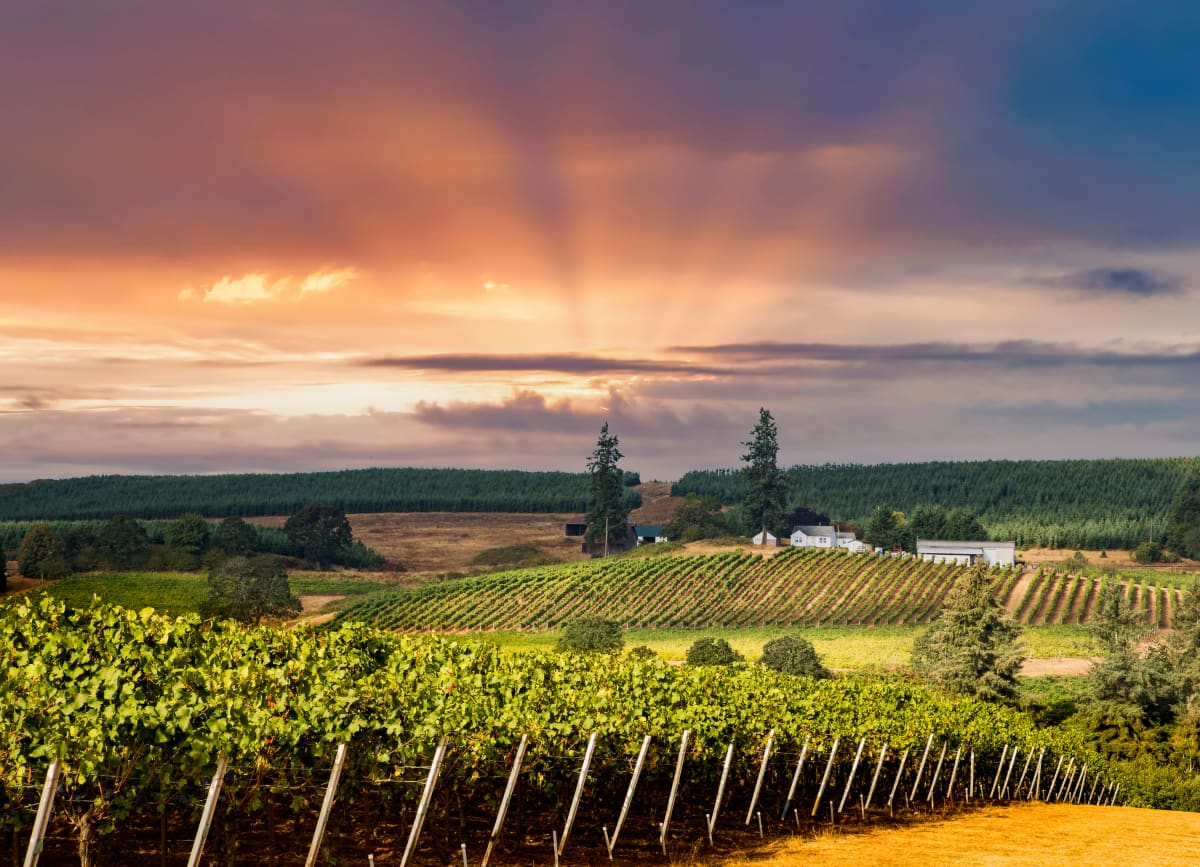
How is a vineyard property financed?
Not every vineyard is an agricultural loan — the financing depends on scale and income. A small hobby vineyard on a residential parcel can often go conventional or jumbo, treated as a home with vines. A larger estate with meaningful acreage but no commercial production routes to portfolio or land financing. An income-producing vineyard with grape contracts or a working winery underwrites as agricultural or commercial, where the operation's revenue matters. Region shapes it too: the Willamette Valley, Columbia Gorge, Southern Oregon, Napa/Sonoma, Central Coast, and Sierra Foothills each carry different comp, water, and zoning dynamics.
Best for: Buyers of hobby, estate, or producing vineyards across Oregon and California wine regions
Vineyard properties confuse most mortgage lenders. They look residential, they live agricultural, and the income — when there is any — can come from grape sales, custom-crush arrangements, vineyard management leases, wine clubs, or event hosting. A buyer who walks into a retail bank asking for a loan on a 35-acre Willamette Valley pinot noir estate will often get bounced between the residential desk and the commercial desk, with neither one quite sure how to underwrite the deal. The truth is that vineyard financing in Oregon and California is one of the most nuanced corners of real estate lending — and the right answer depends almost entirely on three things: the property's primary use, where its income actually comes from, and what AVA it sits in. This post walks through the three main categories of vineyard property (residential, hobby, and income-producing), maps how each one routes to a different loan program, and then digs into how the Columbia Gorge, Willamette Valley, Southern Oregon, California's North Coast, Central Coast, Sierra Foothills, inland valleys, and Southern California change the underwriting math.
The Three Categories of Vineyard Property — and Why the Distinction Drives Everything
Before any conversation about rates, terms, or down payment, the first question a lender has to answer is what kind of vineyard property this actually is. There are three working categories, and they correspond to three very different lending tracks. The first is the residential vineyard: a primary or secondary home where the vines exist as landscape, lifestyle, or a small personal-use crop. The acreage is typically under 10 to 20 acres of plantable land, the wine — if any — is made for personal consumption or small-batch hobby production, and the income generated by the vines is either zero or so small that it doesn't materially contribute to the household's cash flow. These properties usually finance as conventional or jumbo residential loans, sometimes with rural acreage adjustments, and the underwriter looks at the borrower's W-2 or self-employment income exactly the way they would for any other primary or second home. The second is the hobby vineyard: a property where the vines are larger in scale (often 5 to 40 acres planted), where there may be a small commercial bond or a custom-crush relationship producing a few hundred to a few thousand cases per year, but where the vineyard income is supplemental rather than the borrower's primary livelihood. These properties live in a gray zone — too commercial for many residential lenders, too small for many ag lenders — and frequently end up financed with bank statement loans, portfolio jumbo loans, or hybrid ag/residential structures from lenders who can actually look at the whole picture. The third is the income-producing vineyard: a property where the grapes (or finished wine, or a vineyard-management lease arrangement) generate meaningful, documented income that funds the property's debt service. This is true agricultural underwriting territory, where the lender evaluates yield history, grape contracts, lease terms, varietal mix, and AVA designation, and where the loan is sized around the operation's cash flow rather than the owner's personal income. The same physical 80-acre Sonoma property could plausibly finance as any of the three depending on how the buyer plans to use it — and getting the categorization right at the application stage is the single most important step in finding the right loan.
Residential Vineyards: Conventional, Jumbo, and Acreage-Friendly Programs
Most residential vineyard purchases in Oregon and California are properties with a primary home, outbuildings, and a small planted block that the buyer treats as part of the lifestyle. A 7-acre property in the Dundee Hills with two acres of pinot noir, a 5-acre Healdsburg parcel with old-vine zinfandel, a 10-acre Russian River compound with a chardonnay block — these are residential transactions in everything but landscaping. The financing path is usually conventional (up to county loan limits) or jumbo, with the loan structured around the borrower's personal income, debt-to-income ratio, credit, and reserves. The vines are appraised as part of the property but do not contribute income to the underwriting. The key variables that distinguish these loans from a standard suburban purchase are: (1) acreage — Fannie Mae and Freddie Mac generally accept rural properties as long as the appraisal can find comparable sales and the property is not predominantly agricultural in use; (2) outbuildings — winery buildings, equipment sheds, or production facilities can complicate appraisals because they may not contribute to value the way a residential garage would; (3) water — well capacity, water rights, and irrigation infrastructure get scrutinized in California especially, where surface water and groundwater are increasingly regulated; (4) zoning — properties zoned exclusively agricultural (EFU in Oregon, AP in many California counties) can have residential financing restrictions even when the house is the dominant use. For most residential vineyards under $1.5 million in Oregon and under $2.5 million in much of California, a conventional loan up to 97 percent LTV (3 percent down) or a jumbo loan up to 90 percent LTV (10 percent down) works cleanly. Above those thresholds, or on properties with significant ag improvements, a portfolio jumbo or hybrid residential/ag loan becomes the more practical path.
Hobby Vineyards: The Gray-Zone Problem, the $5K Income Threshold, and How to Solve It
Hobby vineyards are where the financing market gets thin — and where the single most important underwriting question is how much income the vines actually generate (or are intended to generate) on an annual basis. The practical dividing line most lenders use is roughly $5,000 per year in vineyard-derived income. If the property currently produces more than about $5,000 per year in grape sales, custom-crush revenue, wine sales, vineyard management lease income, or related agricultural revenue — or if the buyer intends to operate it that way going forward — the property is generally treated as income-producing and will need true agricultural underwriting (with all the documentation, DSCR analysis, and ag loan structure described in the next section). The $5,000 figure isn't a hard regulatory cutoff; it's a practical underwriting threshold that reflects when the agricultural component of the property becomes material enough that the file no longer fits a residential or quasi-residential box. If the property is not currently generating income above that threshold — or if the property could theoretically generate vineyard income but the buyer's intent is purely residential and lifestyle use (planted vines as landscape, personal-consumption winemaking, no commercial sales) — then the file can usually be structured as hobby farm financing on a property that is primary-residential in use. That's the meaningful distinction: hobby vineyard financing is reserved for properties where the home is the dominant use and vineyard income either doesn't exist or is incidental, while properties generating meaningful commercial revenue route to ag underwriting regardless of how lifestyle-oriented they feel. For genuine hobby vineyards (income under the threshold, residential intent), the solutions come from three sources. Hobby farm financing on a primary-residential property typically goes up to 80 percent LTV (20 percent down), with bank statement, portfolio jumbo, and hybrid ag/residential structures all available within that LTV ceiling. The first is bank statement loans: if the borrower is self-employed (in any industry, not just wine) and can show 12 to 24 months of business bank statements with sufficient deposits, a bank statement program can fund a hobby vineyard purchase up to roughly $3 million at up to 80 percent LTV, evaluating the borrower's income from deposits rather than tax returns. The second is portfolio jumbo loans held on a lender's own balance sheet rather than sold to Fannie or Freddie. Portfolio lenders have flexibility to look at ag improvements, outbuildings, and small commercial elements as part of a whole-property valuation rather than disqualifying the loan because of them. The third is hybrid ag/residential structures, where the lender writes the loan based on the borrower's personal income (W-2, self-employment, retirement, investment) while still being comfortable with the agricultural character of the property. Two practical implications: (1) buyers should be clear about their intent at application — telling a residential lender 'I plan to start selling grapes commercially' will reroute the file to ag underwriting, while 'I plan to make personal-consumption wine only' keeps the hobby track open; and (2) buyers acquiring properties with existing vineyard income above the threshold should expect ag underwriting even if they don't personally intend to operate it that way, unless they can demonstrate to the lender (and document) that the commercial activity will be discontinued.
Income-Producing Vineyards: True Agricultural Underwriting
Income-producing vineyards — properties where grape sales, custom crush, vineyard management leases, or estate winery operations generate meaningful documented revenue — finance as agricultural loans. The underwriting is fundamentally different from residential lending. The lender evaluates the vineyard the way they would any other producing farm: historical yield by block and varietal, grape contracts (with whom, at what price per ton, for how many years), lease arrangements (is the vineyard leased to a winery for $X per acre per year, or is the owner farming and selling fruit directly?), operating expenses (vineyard management costs typically run $3,500 to $7,500 per acre per year depending on region and farming intensity), and the resulting net cash flow available to service debt. Loan sizing is built around debt service coverage on the operational income — typically 1.20 to 1.40x DSCR on long-term land loans — with amortizations running up to 25 or 30 years and rate resets or balloons at year 5, 7, or 10. The borrower's personal income matters less; what matters is whether the vineyard's documented cash flow can carry the proposed debt. LTV on agricultural properties with permanent plantings (vineyards, orchards, established perennial crops) is capped at a maximum of 60 percent — meaning 40 percent down at acquisition — reflecting the lender's view that permanent plantings carry replanting risk, varietal obsolescence risk, and slower liquidation in a default scenario than bare farmland. Lenders strongly prefer to see at least three years of yield history and existing grape contracts or lease arrangements in place before underwriting at maximum LTV. New plantings (un-bearing vines) are generally not financed as income-producing because there's no yield history to underwrite to — those properties either need to bridge to income via a residential-track loan during the four-to-seven-year establishment period, or use a true ag construction loan with phased disbursement. Equipment, irrigation infrastructure, and frost-protection systems may be financed separately through equipment loans or operating lines, particularly for larger operations. This is the world Lumen Mortgage's ag lending team works in every day, and it's structurally different from any residential transaction even when the property happens to also include a house.
Columbia Gorge: Cool-Climate Aromatic Whites and a Bi-State AVA
The Columbia Gorge AVA spans both Oregon and Washington along the Columbia River east of Portland, encompassing about 200,000 acres with around 30 wineries and a diverse mix of varietals — pinot gris, riesling, gewürztraminer, syrah, and increasingly tempranillo on the warmer eastern slopes. Vineyard properties here range from small lifestyle parcels in Mosier and The Dalles to larger production-scale operations on the Underwood and Lyle benches. Financing in this region tends to skew toward the hobby and residential categories because the appellation is dominated by smaller wineries (most produce fewer than 5,000 cases per year), and many vineyard owners pair the property with off-farm income from Portland or Hood River. The unique financing wrinkle in the Gorge is the bi-state nature — a property's water rights, zoning, and even tax structure depend on which side of the river it sits on, and lenders need to understand both Oregon EFU and Washington Designated Forest Land or Open Space rules. For Oregon Gorge properties, our agricultural loans Oregon program handles the underwriting; for buyers wanting to bridge a property purchase with future-state vineyard development, a bank statement loan or hybrid ag/residential structure usually works best. Typical Gorge vineyard land trades between $30,000 and $80,000 per planted acre depending on the specific sub-AVA and proximity to Hood River.
Willamette Valley: Pinot Noir, AVA Premiums, and the Hobby-Vineyard Surge
The Willamette Valley is Oregon's flagship wine region and arguably the most active vineyard real estate market in the Pacific Northwest. Spanning roughly 5,200 square miles from Portland south to Eugene, the valley contains 11 sub-AVAs including Dundee Hills, Eola-Amity Hills, Yamhill-Carlton, McMinnville, Ribbon Ridge, Chehalem Mountains, Laurelwood District, Tualatin Hills, Van Duzer Corridor, Lower Long Tom, and Mt. Pisgah. Vineyard land values vary dramatically by sub-AVA — established Dundee Hills pinot noir vineyards routinely trade at $150,000 to $250,000+ per planted acre, while less-recognized sub-AVAs can trade at $50,000 to $90,000 per planted acre. The market has seen a substantial increase in hobby-vineyard purchases over the past five years, as remote work has enabled professionals from Portland, Seattle, San Francisco, and beyond to buy 10-to-40-acre properties with small planted blocks. These buyers frequently need the hybrid financing structures described above because the properties straddle residential and agricultural categorization. For true income-producing vineyards with grape contracts to established wineries, ag lending with operational cash-flow underwriting is the path. For estate operations with bonded wineries, tasting rooms, and event income, the underwriting can blend agricultural and commercial real estate components — a structure where having access to both ag loans and commercial real estate loans through the same lender materially simplifies the transaction. Our agricultural lending across Oregon and California post covers the broader ag underwriting model in more depth.
Southern Oregon: Rogue Valley, Applegate, and Umpqua — Diverse Varietals, Friendlier Land Prices
Southern Oregon's Rogue Valley, Applegate Valley, and Umpqua Valley AVAs offer a different vineyard real estate profile from the Willamette Valley: warmer climate, more varietal diversity (tempranillo, syrah, viognier, cabernet sauvignon, malbec, and bordeaux blends alongside the cooler-climate whites), and land prices that run 30 to 50 percent lower per planted acre. A 40-acre Applegate property with 18 planted acres and a small tasting room might list at $1.4 to $2.2 million — meaningful capital but well below comparable Willamette Valley pricing. The lending considerations in Southern Oregon mirror the broader framework: residential vineyard purchases route through conventional or jumbo programs, hobby vineyards work best with bank statement or portfolio jumbo loans, and income-producing vineyards with documented grape sales or wine-club revenue route to ag underwriting. The region has a high concentration of small-batch estate wineries, and many vineyard properties include tasting-room revenue, wine-club subscriptions, and event hosting income — all of which can be evaluated as part of a multi-stream ag or hybrid underwriting analysis. For buyers planning to relocate from California to Southern Oregon to start or expand a wine operation, the income-producing vineyard path with ag underwriting and a phased construction or improvement budget is often the cleanest structure.
California North Coast: Napa, Sonoma, Mendocino, Lake — Premium Pricing and Specialized Lenders
California's North Coast — Napa, Sonoma, Mendocino, and Lake counties — is the highest-priced vineyard real estate market in the country and has the most specialized lender ecosystem to match. Napa Valley vineyard land routinely trades at $300,000 to $700,000+ per planted acre in premier sub-AVAs (Rutherford, Oakville, Stags Leap, To Kalon), with estate properties including residences and winery buildings transacting at $10 million to $50 million+ regularly. Sonoma County, while less expensive than Napa, still commands $100,000 to $400,000 per planted acre depending on sub-AVA (Russian River, Dry Creek, Alexander Valley, Sonoma Coast all carry different premiums). Mendocino and Lake counties are meaningfully more accessible, with planted vineyard land trading in the $40,000 to $100,000 per acre range. The lending universe for North Coast vineyards is dominated by specialty agricultural lenders, life insurance companies, and a small number of large commercial banks that have built specialized wine industry lending desks. For income-producing North Coast estates — meaning operations with significant grape revenue, custom crush relationships, or estate wine production — true ag underwriting with DSCR-driven loan sizing is the standard structure. For residential-track buyers (which exist even at the high end: a buyer purchasing a $4M Napa property as a personal residence with a few acres of vines as landscape) jumbo residential financing with portfolio lender flexibility is often the cleanest path. The complexity that comes up most often in this market is the combined-use property: a buyer purchasing a Napa estate that includes a residence, a small vineyard, a tasting room, and an events business needs financing that can evaluate all four components in a single transaction. This is where having a lending team with access to residential, agricultural, and commercial real estate loan options under one roof becomes a meaningful structural advantage.
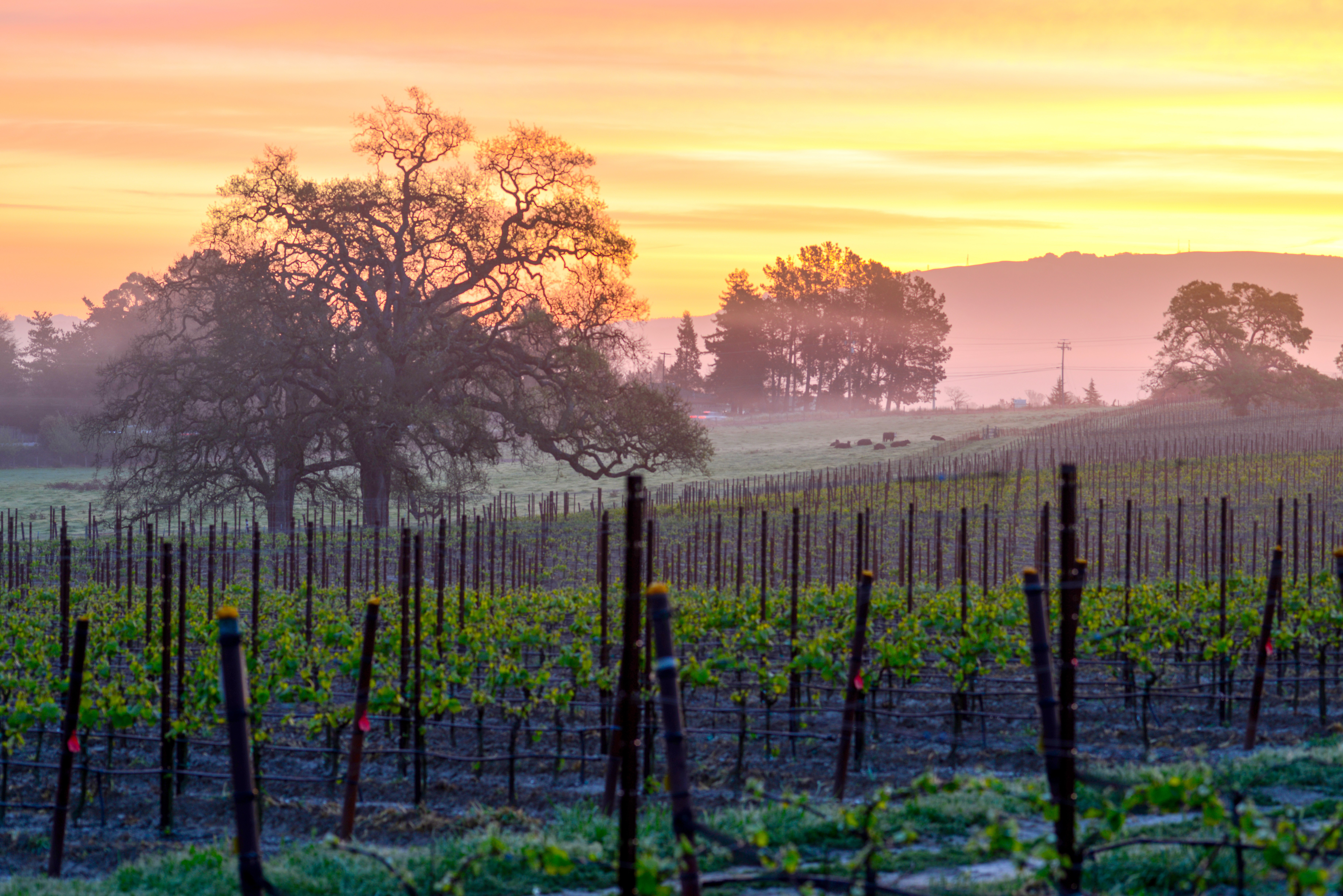
California Central Coast: Paso Robles, Santa Barbara, Monterey — Scale Producers and Production Vineyards
The Central Coast — Paso Robles, Santa Maria, Santa Ynez, Sta. Rita Hills, and Monterey County — is California's largest vineyard production region by acreage, with a meaningful share of the planted acres dedicated to large-scale production vineyards selling to broad-market wineries. Paso Robles alone contains roughly 40,000 planted acres across 11 sub-AVAs, with land values ranging from $20,000 to $60,000 per acre on the east side to $50,000 to $150,000+ per acre on the higher-quality west side. Santa Barbara County's Sta. Rita Hills and Santa Maria Valley carry significantly higher per-acre pricing for cool-climate pinot noir and chardonnay. Central Coast vineyard financing skews more heavily toward true income-producing ag underwriting because the average property in this region is materially larger and more commercial in character — 80, 150, 300+ acre operations with multi-year grape contracts to wineries throughout California. Ag lenders evaluate these properties on yield history, contract revenue, lease income (many large vineyards are leased to wineries that farm the vines themselves and pay the landowner a per-acre lease), and the resulting cash flow against the proposed debt. Loan sizes in the $3M to $25M+ range are routine, and life insurance company loans become a competitive financing source at the upper end of this range. For smaller Central Coast properties — say a 40-acre Paso west side estate vineyard with a residence and a modest custom-crush program — the hybrid ag/residential structure remains the most common path. Our life company loans post covers the institutional ag lending side of this market in more detail.
Sierra Foothills: Old-Vine Zinfandel, Elevation Diversity, and Mid-Market Pricing
The Sierra Foothills AVA — encompassing El Dorado, Amador, Calaveras, and parts of Nevada, Placer, Mariposa, and Tuolumne counties — is one of California's oldest wine regions, with vineyard plantings dating to the Gold Rush and a heritage of old-vine zinfandel that doesn't exist anywhere else in the state. The region offers vineyard real estate at meaningfully lower price points than the coastal markets — typical Foothills vineyard land trades in the $25,000 to $70,000 per planted acre range, with premium properties in the higher El Dorado sub-AVAs reaching $80,000 to $120,000 per acre. Elevation matters significantly: properties at 1,500 to 2,500 feet have very different growing conditions, varietal mixes, and risk profiles than valley-floor parcels. The hobby and lifestyle vineyard category is well-represented in the Foothills — many purchasers are buying second homes or relocating from the Bay Area for a smaller-scale vineyard lifestyle — and bank statement loans, portfolio jumbo loans, and hybrid ag/residential structures all see meaningful use here. Income-producing Foothills vineyards with grape contracts to Lodi, Bay Area, or out-of-region wineries finance through standard ag underwriting, with the added consideration that older zinfandel blocks (some over 100 years old) carry premium grape pricing that supports stronger debt service coverage than the per-acre land value alone would suggest.
Inland Valleys: Lodi, Clarksburg, San Joaquin — Production Scale and Different Underwriting
California's inland valleys — Lodi, Clarksburg, the broader San Joaquin and Sacramento Valley wine regions — operate at a fundamentally different scale than the coastal premium markets. Lodi alone produces roughly 20 percent of California's total wine grape tonnage from properties that frequently run 200 to 1,000+ acres. Vineyard land here trades at $15,000 to $40,000 per planted acre for typical production vineyards, with old-vine zinfandel blocks and premium sub-AVA properties reaching $50,000 to $80,000 per acre. The financing model in the inland valleys is dominated by true commercial ag lending: large operations, multi-year grape contracts to brand-name wineries, sophisticated operating budgets, and lenders who specialize in scale wine grape production. Down payments of 40 percent (the 60 percent LTV cap on permanent-planting ag loans), amortizations of 20 to 25 years on land, and DSCR-driven loan sizing in the 1.25 to 1.40x range are standard. Life insurance company loans, Farm Credit System loans, and specialized agricultural commercial banks dominate the upper end of this market. For smaller hobby or lifestyle parcels within the inland valley footprint — they exist, particularly in the Clarksburg area near Sacramento and in the foothills bordering Lodi — the residential and hybrid paths described above apply, but the scale of the market is meaningfully different from the coastal regions.
Southern California: Temecula, Cucamonga, and Emerging AVAs
Southern California's wine regions — Temecula Valley, Cucamonga Valley, Ramona Valley, and the South Coast AVA more broadly — are smaller in total acreage but include a mix of established production operations, boutique estate wineries, and lifestyle vineyards within reach of the Los Angeles and San Diego metropolitan areas. Temecula Valley is the largest and most developed, with roughly 40 wineries and vineyard properties typically trading at $40,000 to $120,000 per planted acre depending on location and water access. Water rights and drought resilience are particularly important underwriting factors in Southern California vineyards — lenders evaluate well depth, water table data, and irrigation district status as part of the appraisal process. Many Southern California vineyard buyers are professionals from the LA basin purchasing second-home or lifestyle properties, which means the hobby vineyard and residential vineyard financing paths see heavy use. For Temecula or Cucamonga properties with bonded wineries, tasting rooms, and event income, the hybrid ag/residential or full ag underwriting paths apply depending on income scale. The smaller, less-recognized Southern California AVAs (Ramona, Antelope Valley, Malibu Coast) generally finance as residential transactions because vineyard income is modest and the residential component dominates the property's value.
Why a Lender with Ag, Residential, and Portfolio Options Under One Roof Matters
The throughline of every category and every region in this post is that the same physical vineyard property can route to three or four entirely different loan programs depending on how the buyer plans to use it and how the income is structured. A lender that only does residential loans will force the deal into a residential box even when an ag loan would be better. A lender that only does ag loans will struggle with hobby vineyards and lifestyle properties where the borrower's personal income is the actual repayment source. A lender that only sells to Fannie and Freddie cannot accommodate the property characteristics — bonded wineries, tasting rooms, agricultural outbuildings, irregular parcels — that show up on most vineyard transactions. The cleanest experience for a vineyard buyer comes from working with a lending team that can actually look at the property and the borrower and quote across all the relevant programs in parallel: conventional, jumbo, bank statement, portfolio jumbo, hybrid ag/residential, true agricultural, and commercial real estate where appropriate. That's the model Lumen Mortgage runs — residential lending across 25+ programs, ag lending across multiple structures, and commercial real estate financing for the largest estate operations, all underwritten by the same team, all looking at the same property and the same borrower file. For vineyard buyers in Oregon and California, that means you get an honest answer about which program actually fits — rather than the program that happens to be the one the lender in front of you can sell.
Modeling the Numbers Before You Make an Offer
Before you write an offer on any vineyard property, the most important financial exercise is to model the proposed debt service against the property's realistic cash flow (for income-producing or hybrid properties) or your personal income (for residential vineyards). Down payment, amortization, payment frequency, and the interest rate environment all interact. Our free agricultural loan calculator lets you input purchase price, down payment percentage, interest rate, and amortization period (20, 25, or 30 years) and see the resulting monthly, quarterly, semi-annual, or annual payment along with the full amortization schedule. For hybrid vineyard properties where you want to compare a residential-track loan against an ag-track loan, modeling both side-by-side on the calculator gives you the actual numerical trade-off — typically a higher rate but more flexible structure on the ag side, versus a lower rate but stricter property and income criteria on the residential side. Running these numbers before you make an offer lets you walk into the negotiation knowing exactly what loan structure you're targeting, what your monthly carrying cost will be, and what the cash-to-close requirement looks like across different financing paths.
Model Your Farm Loan
Agricultural Loan Calculator
Agricultural loans work differently from residential mortgages — larger required down payments, sometimes shorter amortization periods, and monthly carrying costs that need to work against seasonal income rather than a steady paycheck. Before you make an offer on farmland or a rural property, knowing your payment scenario shapes the entire negotiation.
The ag loan calculator lets you model purchase price against the 25–35% down payments typical of farm lending, compare 20-, 25-, and 30-year amortization schedules, and see how rate variations move your monthly carrying cost. For a cash-flowing operation, that monthly number is as important as the land price itself.
Down payment scenarios
Model your monthly payment at 25%, 30%, and 35% down — the range most ag lenders require on farm purchases.
Amortization comparison
See how 20-yr vs. 25-yr vs. 30-yr amortization changes your monthly payment and total interest paid over time.
Rate sensitivity
Small rate differences compound significantly over long amortizations on large balances. See the real magnitude.
Free · No login · No credit pull required
CPA / Tax Pro Referral
Vineyard purchase? A wine-country CPA pays for itself.
Vineyard tax structuring is its own discipline — capitalized vine establishment costs, alternative depreciation system rules, hobby-loss vs. trade-or-business characterization, and conservation easement options unique to ag land. We can introduce you to CPAs who work with vineyards in the Willamette Valley, Rogue Valley, Napa, Sonoma, and the Sierra Foothills. Personal email intro, no fees.
No directory. No paid placements. No RESPA-restricted referral fees. We've worked alongside these pros on real Oregon and California deals — we'll make a personal email introduction so you can interview them yourself.
Or email us directly:
How do I finance a vineyard property in Oregon or California?
It depends on three factors: the property's primary use, how much income the vines generate (or are intended to generate), and the AVA. Residential vineyards (home with vines as landscape, no vineyard income) finance as conventional or jumbo residential loans. Hobby vineyards (primary-residential use, vineyard income under roughly $5,000/year, or none at all) typically use bank statement loans, portfolio jumbos, or hybrid ag/residential structures. Income-producing vineyards (vineyard revenue above the ~$5K threshold — including grape sales, custom crush, leases, or estate wine production) generally need true agricultural underwriting based on property cash flow. The same physical property can route to different programs depending on intent and existing revenue — getting the categorization right at application is the most important step.
Best for: Buyers evaluating a vineyard property purchase anywhere in Oregon or California — residential, hobby, or income-producing — who want clarity on which loan program actually fits before writing an offer.
The Three Vineyard Financing Tracks Side-by-Side
Same property, different use case — different loan structure
| Residential Vineyard | Hobby Vineyard | Income-Producing Vineyard | |
|---|---|---|---|
| Vineyard Income Threshold | None / personal-use only | Under ~$5,000/year (or zero) | Above ~$5,000/year |
| Typical Planted Acres | < 10–20 | 5–40 (residential-intent) | Any scale with commercial revenue |
| Primary Loan Program | Conventional / Jumbo | Bank Statement / Portfolio / Hybrid | True Agricultural |
| Income Underwriting | Personal W-2 / Self-employed | Bank deposits or personal income | Property cash flow (yields, leases, contracts) |
| Maximum LTV | Up to 97% (conv) / 90% (jumbo) | Up to 80% | Max 60% (permanent plantings) |
| Minimum Down Payment | 3% (conv) / 10% (jumbo) | 20% | 40% |
| Typical Amortization | 30 years | 30 years (or 25 on portfolio) | 20–30 years (5/7/10 resets) |
| Bonded Winery OK? | Usually no | Yes with portfolio/hybrid | Yes — standard |
| Tasting Room / Events | Not evaluated | Not evaluated (income via deposits) | Underwritten as part of cash flow |
| Vineyard Income Counted | No | Indirectly (via bank deposits) | Yes — primary basis |
| Min. DSCR / Coverage | DTI-based, not DSCR | DTI or deposits | 1.20–1.40x DSCR |
| Best For | Lifestyle / home with vines | Lifestyle + small commercial production | Working vineyard operations |
Vineyard Land Pricing by Region
Typical planted-acre values across Oregon and California wine regions, May 2026
| Region | Typical Range / Planted Acre | Dominant Loan Track | |
|---|---|---|---|
| Columbia Gorge (OR / WA) | Columbia Gorge | $30K – $80K | Residential / Hobby / Ag mix |
| Willamette Valley — Dundee Hills | WV — Dundee Hills | $150K – $250K+ | Residential / Hobby (high end) |
| Willamette Valley — other sub-AVAs | WV — other AVAs | $50K – $120K | Hobby / Hybrid / Ag |
| Southern Oregon (Rogue/Applegate/Umpqua) | Southern OR | $25K – $75K | Hobby / Hybrid / Ag |
| Napa premier sub-AVAs | Napa premier | $300K – $700K+ | Jumbo / Portfolio / Ag (large estates) |
| Sonoma (Russian River, Dry Creek, etc.) | Sonoma | $100K – $400K | Jumbo / Portfolio / Ag |
| Mendocino / Lake | Mendocino / Lake | $40K – $100K | Hybrid / Ag |
| Paso Robles (east vs. west) | Paso Robles | $20K – $150K | Ag (most), Hybrid (smaller) |
| Santa Barbara (Sta. Rita Hills, SMV) | Santa Barbara | $80K – $200K+ | Ag / Hybrid |
| Sierra Foothills | Sierra Foothills | $25K – $120K | Hobby / Hybrid / Ag |
| Lodi / inland valleys | Lodi / inland | $15K – $80K | Ag (production scale) |
| Temecula / Southern CA | SoCal | $40K – $120K | Hobby / Hybrid / Ag |
97%
Conventional Max LTV
90%
Jumbo Max LTV
80%
Hobby Farm Max LTV
60%
Ag Permanent-Plantings Max LTV
1.20–1.40x
Target DSCR (Ag)
Up to 30 yrs
Land Amortization (Ag)
$3.5K–$7.5K / ac / yr
Vineyard Mgmt Cost
4–7 years
Vine Establishment
Monthly / Qtr / Annual
Payment Frequency Options
OR & CA
Lumen Footprint
Residential + Ag + CRE
Programs Available
Frequently Asked Questions
What are the three categories of vineyard property and why does it matter for financing?
Can I finance a small Oregon or California vineyard property with a conventional loan?
How do agricultural loans evaluate a vineyard's income for underwriting?
Why do Napa or Willamette Valley vineyards cost so much more per acre than other regions?
Can I finance a vineyard with new (un-bearing) plantings?
How do bonded wineries, tasting rooms, and event income affect financing?
What down payment (and maximum LTV) should I expect on different vineyard loan types?
Are vineyard loans available on properties zoned exclusively agricultural (EFU in Oregon)?
Why does working with a lender that offers ag, residential, and portfolio loans matter for vineyard purchases?
Looking for Ag Financing?
Farm purchase, ranch, raw land, operating lines, and specialty crop loans — structured around how your operation actually works.
Bottom Line
Vineyard properties in Oregon and California are some of the most rewarding real estate purchases possible — and some of the most poorly served by mainstream mortgage lenders. The path between a 5-acre lifestyle vineyard in the Dundee Hills, a 25-acre hobby estate in the Applegate, a 60-acre custom-crush operation in Paso Robles, and a 300-acre Lodi production vineyard runs through four completely different loan programs, and getting the categorization right at the start determines whether the transaction closes smoothly or stalls for months. If you are considering a vineyard purchase anywhere in Oregon or California — whether residential, hobby, or income-producing, whether in the Columbia Gorge, Willamette Valley, Southern Oregon, North Coast, Central Coast, Sierra Foothills, inland valleys, or Southern California — the most valuable first step is a free vineyard financing consultation with a team that actually does residential, agricultural, and portfolio lending together. Call the Lumen Mortgage team at 503-966-9255 or email info@lumenmortgage.com to schedule a vineyard financing consultation. We will walk through the property, the use case, the income structure, and the realistic financing paths — and give you an honest assessment of which loan program fits best before you write the offer. Want to model the payment math first? Try our free agricultural loan calculator to estimate monthly, quarterly, or annual payments across 20-, 25-, and 30-year amortization scenarios.
Previous
Maximizing DSCR and Cash Flow with Interest-Only Payments: A 2026 Six-City Comparison (Portland, Eugene, Sacramento, San Francisco, Los Angeles, Orange County)
Next
Assumable FHA & VA Loans: A Buyer’s Guide to Inheriting a 3% Mortgage in Today’s 6% Market — Portland and San Francisco Scenarios

