Agricultural Lending
Education Center
Everything you need to know about financing farm, ranch, and agricultural property in Oregon and California — from water rights and EFU zoning to down payments and Farmer Mac programs.
Quick Answer Guides
Common Agricultural Lending Questions
Each page answers one specific question with a direct answer, key facts, and detailed sections — optimized for fast comprehension and AI search citation.
How Do You Finance a Vineyard Property?
Vineyard financing splits across the same three-product framework that handles other working ag estates: Conforming Conventional below the local conforming limit ($832,750 in most California Sierra Foothills wine counties for 2026 — usually too small for a working vineyard), our Ranch Home Loans jumbo at 75% LTV with up to 80% CLTV (the right fit for owner-occupant buyers running hobby- to mid-scale wine production with Schedule F income), and our true Ag loan options at up to 70% LTV (the right fit for commercial wine producers, investor-buyers, and use-permit-driven venue and event operations). Standard residential jumbo programs almost never close on a working vineyard — acreage caps, ag-zoning overlays, and Schedule F disqualifiers collapse the LTV math.
What Is an Agricultural Loan?
An agricultural loan is a mortgage specifically designed to finance farm, ranch, timberland, and other agricultural properties. Unlike residential mortgages, ag loans are underwritten against farm income (Schedule F with depreciation add-backs), require 25–35% down payments, use specialized agricultural appraisers, and can be structured with seasonal payment schedules aligned to harvest cycles. Lumen Mortgage offers ag loans from $250,000 to over $10 million through Farmer Mac-approved programs with fixed-rate terms up to 30 years.
How Do You Finance Farmland in Oregon and California?
Financing farmland in Oregon and California requires an agricultural lender experienced with the unique regulatory complexity of both states. Oregon's EFU zoning and prior appropriation water rights, and California's SGMA groundwater restrictions, Prop 13 reassessment rules, and specialty crop volatility all create underwriting layers that don't exist in other states. Expect 25–35% down, specialized agricultural appraisals ($5,000–$15,000+), and 4–6 week appraisal timelines. Lumen Mortgage finances farm and ranch properties in both states through Farmer Mac-approved programs.
What Are Farm Loan Down Payment Requirements?
Farm loan down payments typically range from 25% to 40% depending on the property type and program. Working farmland with demonstrated income generally requires 25–30% down. Raw agricultural land with no improvements may require 35–40%. USDA Farm Service Agency (FSA) guaranteed loans offer as low as 5% down for qualifying beginning farmers, but come with strict eligibility requirements and longer processing timelines. Some portfolio agricultural lenders offer 20% down for strong borrowers with proven farming experience and robust cash flow.
How Do Water Rights Affect Farm Mortgages?
Water rights are one of the most consequential factors in agricultural lending — particularly in Oregon and California. A farm with senior water rights and reliable irrigation may be worth $8,000+/acre, while the same land without water rights might appraise at $3,000/acre. Lenders verify the water right type (surface or groundwater), priority date, authorized quantity, and whether any forfeiture or curtailment proceedings are pending before approving an ag loan. In California, SGMA groundwater restrictions add another layer — potentially reducing pumping allocations by 20–40% in overdrafted basins by 2040.
How Do Agricultural Loans Work in the Sierra Foothills (Placer, Nevada & El Dorado Counties)?
The California Sierra Foothills — anchored by Placer, Nevada, and El Dorado counties — is one of the densest concentrations of working ag land within commuting distance of a major metro in the western United States. Financing it correctly means matching the property to one of three products: Conforming Conventional below the local loan limit ($832,750 in all three counties for 2026, but rarely sufficient for a working ag estate), our Ranch Home Loans portfolio jumbo at 75% LTV / 80% CLTV up to $2,000,000 (the right fit for owner-occupant buyers on equestrian, vineyard, orchard, and small-cattle properties), and our true Ag loan options at up to 70% LTV (the right fit for commercial-scale wine, cattle, orchard, or multi-residence ranches, investor-buyers, and properties with material event/venue revenue). Williamson Act contracts, AE/AG/FR zoning overlays, NID/PCWA/EID water rights, and Cal Fire SRA defensible-space requirements all materially shape which product underwrites the deal.
Key Topics
What Makes Ag Lending in Oregon & California Different
Water Rights
Prior appropriation in Oregon, SGMA groundwater restrictions in California — water rights can swing land value by $3,000–$8,000+/acre and are the single most consequential factor in ag collateral valuation.
EFU Zoning & Land Use
Oregon's Exclusive Farm Use zoning is the strictest farmland preservation system in the U.S. — no subdivision, no rezoning, no development premium. Lenders must underwrite purely on agricultural merit.
Down Payments & LTV
Farm purchases require 25–35% down (up to 40% for raw land). FSA beginning farmer programs offer as low as 5%. Water rights, improvements, and income history all affect required equity.
Schedule F Income
Ag lenders analyze 2–3 years of Schedule F with depreciation add-backs — not face-value taxable income. This distinction is often the difference between qualifying and being declined.
Farmer Mac Programs
The secondary market for ag loans offers fixed-rate terms up to 30 years with no prepayment penalty — but requires appraisers with demonstrated competency in the specific crop type and geography.
Prop 13 & SGMA Risk
In California, Prop 13 reassessment on transfer can increase taxes 5–6x, and SGMA may fallow 500K–1M irrigated acres by 2040. Both create hidden costs that must be modeled in underwriting.
Agricultural Glossary
Key Terms Every Ag Borrower Should Know
All 12 terms are defined in detail in our Mortgage Glossary under the Agricultural category.
From the Blog
Agricultural Lending Articles
In-depth guides on ag equity lines, fixed-rate farm loans, water rights, and more.
From the Blog
Further Reading
 Agricultural
Financing an 80-Acre Equestrian and Cattle Ranch in Grass Valley, California: Where Ranch Home Loans Tops Out and True Ag Lending Begins on a $3.95M Multi-Residence Income Property
A real-world walkthrough of how to finance a representative 80-acre legacy ranch in Grass Valley, Nevada County — three to four residences across two APNs, a 16-stall barn with office, a 6-stall mare motel, covered and outdoor arenas, a covered round pen, hot walker, cutting arena, cattle squeeze, irrigated cross-fenced pastures, two ponds, an orchard, and a 4-bay metal shop. At a $3.95M price point this property sits above the Ranch Home Loans loan-amount ceiling and squarely in true Ag-loan territory. We compare what each product can actually fund: standard residential jumbo (functionally unworkable on multi-residence, multi-APN, dual-livestock-operation properties), Ranch Home Loans at its $2M ceiling (a layered piece, not a complete solution), and our in-house true Ag loan options at up to 70% LTV (the primary product on commercial-scale equestrian and cattle operations).
 Agricultural
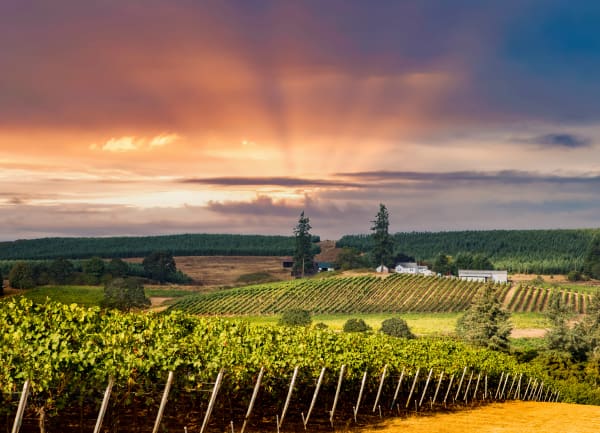
Financing Vineyard Properties in Oregon and California: How Use, Income, and Region Shape Your Loan Options
Not every vineyard is an agricultural loan. A 5-acre hobby block in Dundee, a 40-acre estate in Sonoma, and a 220-acre Paso Robles producer with grape contracts each route to a completely different financing program. This guide walks through residential vineyard, hobby vineyard, and income-producing vineyard underwriting — and how the Columbia Gorge, Willamette Valley, Southern Oregon, North Coast, Central Coast, Sierra Foothills, inland valleys, and Southern California shape your options.
 Agricultural
How a Sheridan, Oregon Farmer Used an Ag Cash-Out Refinance to Buy His Neighbor’s Farm Before It Hit the Market
A Yamhill County farmer owned his property free and clear. When the neighbor’s adjacent parcel was about to list with a realtor, he took a $1M ag cash-out refinance with a 30-year fixed term and flexible annual payments — and closed the deal before a single sign went in the ground.
Have a Farm or Ranch Financing Question?
Our ag lending specialists understand water rights, EFU zoning, Schedule F underwriting, and the unique economics of Oregon and California agriculture. No pressure, no obligation.
Licensed in Oregon & California · NMLS #1498678