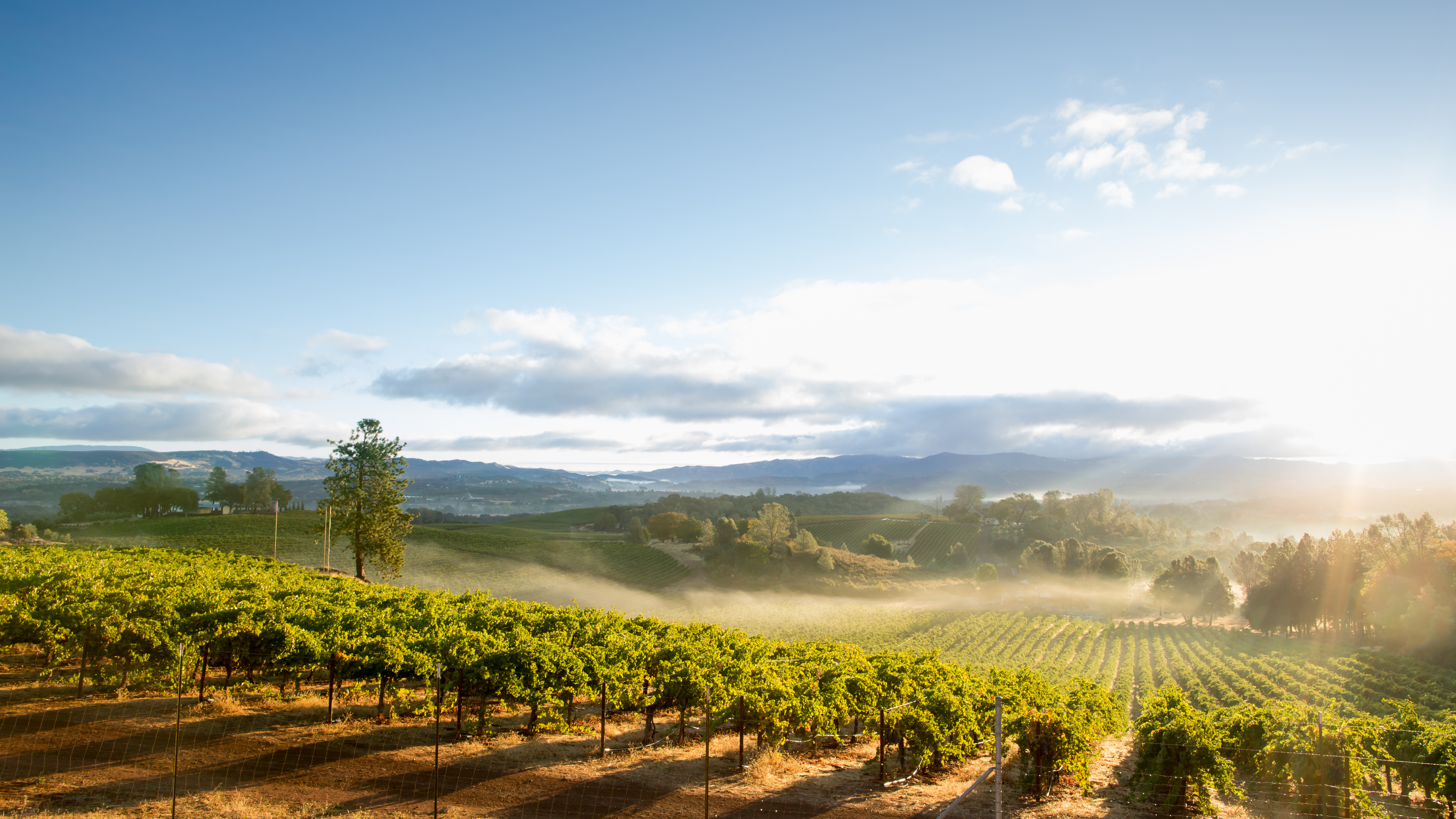
How Do You Finance a Vineyard Property?
Vineyard financing splits across the same three-product framework that handles other working ag estates: Conforming Conventional below the local conforming limit ($832,750 in most California Sierra Foothills wine counties for 2026 — usually too small for a working vineyard), our Hobby Farm Loans jumbo at up to 80% LTV, stepping down by loan size and acreage (the right fit for buyers running hobby- to mid-scale wine production who qualify on outside income — Schedule F income is allowed but not counted toward qualifying), and our true Ag loan options at up to 70% LTV (the right fit for commercial wine producers, investor-buyers, and use-permit-driven venue and event operations). Standard residential jumbo programs almost never close on a working vineyard — acreage caps, ag-zoning overlays, and Schedule F disqualifiers collapse the LTV math.
Key Facts
Why Working Vineyards Don't Fit Standard Lending
Three structural reasons most national jumbo programs can't close on a working vineyard: (1) acreage caps — most residential jumbo overlays cap creditable acreage at 10–20 acres, immediately excluding 10+ acres of producing vines from value on a 30-acre estate; (2) ag-zoning and Schedule F overlays — most residential jumbo guidelines disqualify properties with active commercial farming, regardless of how strong the residence is; (3) appraiser availability — national lenders use panels concentrated in Sacramento, Bay Area, or coastal markets, and those appraisers don't have local Sierra Foothills or Willamette Valley wine country comps. Properties pro-rated against undersized residential comps come back $300K–$500K under list, collapsing the LTV math.
Conforming Conventional: Rarely the Whole Answer on Wine Country
Conforming Conventional is capped at the county loan limit — $832,750 in Nevada, Placer, El Dorado, and most other California Sierra Foothills counties for 2026. On a typical $2M+ working vineyard estate, that's well under the loan amount needed at any reasonable down payment. Conforming Conventional is still worth checking for smaller wine country acquisitions or as a layered piece of a larger financing structure, but it isn't the primary vehicle on most vineyard purchases over roughly $1M.
Hobby Farm Loans: The Jumbo Built for Wine Country
Hobby Farm Loans is our portfolio jumbo built for residences on rural and ag-zoned acreage. The Hobby Farm tier explicitly accepts Schedule F farm income (allowed but not counted toward qualifying), vineyard infrastructure (trellising, deer fencing, irrigation lines), NID and similar transferable water rights, multiple parcels under common ownership, and meaningful acreage with no cap. Loans go up to $5,000,000, at 80% LTV (20% down) up to $2,000,000, with max LTV stepping down above that and by acreage (80% under 10 acres, 75% at 10–20 acres, 70% at 20+). Terms are 3/1, 5/1 and 7/1 ARMs and a 30-year fixed, with 40-year amortization on primary residences. Self-employed vineyard owners qualify on a tax-return analysis sheet plus 2 years of business history. The product fits buyers running hobby-farm to mid-scale wine production with their own label or selling fruit/bulk wine.
When a True Ag Loan Beats Hobby Farm Loans on a Vineyard
Three borrower profiles where our Ag loan options outperform Hobby Farm Loans even at lower LTV: (1) the buyer is acquiring the property as an investment to rent out rather than owner-occupy — Hobby Farm Loans is residence-first; our Ag loans underwrite the operating asset; (2) the operation has scaled past hobby-farm levels into true commercial wine production, custom crush, substantial wholesale/distribution, or its own bonded winery — Ag underwriting captures the operating components in the financed package; (3) the property has a use permit for events, weddings, or tasting-room hospitality and that revenue is material to the buyer's plan — Ag underwriting can holistically credit residence, vineyard, outbuildings, water rights, and venue revenue rather than excluding the commercial layer. The tradeoff is LTV: 70% on Ag vs. up to 80% on Hobby Farm Loans (depending on loan size and acreage). We keep these loans in-house.
Multi-Parcel Wine Properties Under One Loan
Many California wine country estates are structured across multiple parcels — common in Nevada County, Sonoma County, and the Sierra Foothills generally. Both Hobby Farm Loans and our Ag loan options can finance multi-parcel properties as a single transaction when the parcels are contiguous, under common ownership, used as one functional estate, and titled together at closing. Standard residential jumbo overlays will only finance one parcel and exclude the others from value entirely — which is why a 30-acre, three-parcel Grass Valley vineyard estate often won't appraise to list price on a residential jumbo even before the ag overlays kick in.
AG Zoning, Use Permits, and Event Income
AG zoning with a use-permit pathway (events, weddings, tasting room) is fundable on Hobby Farm Loans as long as the property remains residence-first and the buyer is not relying on event income to qualify — the use permit becomes a value enhancer rather than a debt-service input. If the buyer's plan depends on materially building out the event/venue side of the property, our Ag loan options can underwrite the holistic asset including projected venue revenue and the commercial buildout. The deciding question: does the loan need to be residential-first with ag/event upside, or is the buyer underwriting the property as a commercial wine-and-events operation?
What Vineyard Appraisers Need to Credit
Three line items that determine whether a vineyard appraises at list or 10–15% below: (1) producing-vine value — established vines (10+ years old) carry material market value beyond bare land; the appraiser must credit the producing acreage at vineyard-comp value, not raw-land comp value; (2) water rights — NID (Nevada Irrigation District), PCWA (Placer County Water Agency), and similar transferable irrigation rights add significant value when the appraiser understands the local water-rights structure; (3) infrastructure — trellising, deer fencing, drip irrigation, equipment buildings, and any wine-production outbuildings need to be valued, not excluded. Hobby Farm Loans and our Ag loan options both use appraisers who understand Sierra Foothills, North Coast, and Willamette Valley wine country.
Decision Tree: Which Product Fits Which Vineyard Buyer
Walk these in order: (1) Loan-size check — under your county's conforming limit and tiny vineyard? Conforming Conventional first. (2) Owner-occupancy — buying to live there with your own label or hobby-farm wine production? Hobby Farm Loans. (3) Operation scale — commercial wine production with bonded winery, custom crush, substantial wholesale, or material event/venue revenue? Our true Ag loan options. (4) Investor profile — buying as an investment to rent out to a vineyard manager or hospitality operator? Our true Ag loan options. (5) Multi-parcel and use-permit complexity — both Hobby Farm Loans and Ag handle them; standard residential jumbo typically can't. For a worked example on a $2.29M, 30-acre Grass Valley wine property, see our Nevada County vineyard estate case study.
Three Loan Products for a Vineyard Estate — Side by Side
Structural comparison across loan size, LTV, owner-occupancy, and how each product treats acreage, vineyard infrastructure, multi-parcel ownership, and use-permit/event income.
| Conforming Conventional | Hobby Farm Loans (Ours) | Our True Ag Loan Options | |
|---|---|---|---|
| Max Loan Amount | $832,750 (most CA wine counties, 2026) | Up to $5,000,000 (80% LTV to $2M, steps down above) | Up to $25,000,000 |
| Max LTV | 97% LTV (program-dependent) | 80% to $2M; steps down above $2M and by acreage | Up to 70% LTV |
| Working Vineyard Allowed | Allowed | Allowed (Hobby Farm tier) | Built for commercial-scale wine production |
| Acreage Allowed | Generally allowed | No acreage cap (Hobby Farm) | No cap; ag-underwritten |
| Multi-Parcel Single Loan | Single parcel only typical | All parcels in one loan | All parcels in one loan |
| Vineyard Infrastructure Value | Limited credit | Full credit (trellising, irrigation, fencing) | Full credit incl. operational components |
| Use Permit / Event Income | Not creditable | Value enhancer; income not required | Underwritten as part of operation |
| Owner-Occupied vs. Investor | Owner-occupied or 2nd home | Owner-occupied or 2nd home | Investor / rental use allowed |
| Self-Employed Documentation | Tax returns required | Tax-return analysis + 2 yrs business history | Holistic ag P&L review |
| Best For | Smaller acquisitions or layered piece | Owner-occupied vineyards with hobby- to mid-scale wine production | Investor-owned wine country, commercial-scale production, or material event/venue revenue |
CPA / Tax Pro Referral
Ag tax planning is a different sport.
Schedule F characterization, Section 179, conservation easements, capitalized vine/orchard establishment costs — ag CPAs save their clients more in a single tax year than they cost in five. We can introduce you to OR/CA ag-focused CPAs who handle vineyards, ranches, orchards, and hobby-farm operations.
No directory. No paid placements. No RESPA-restricted referral fees. We've worked alongside these pros on real Oregon and California deals — we'll make a personal email introduction so you can interview them yourself.
Or email us directly:
Licensed in Oregon & California · NMLS #1498678
From the Blog
Further Reading
 Vineyard
Financing a 30-Acre Vineyard Estate in Grass Valley, California: Conventional vs. Hobby Farm Loans vs. Ag Loans on a $2.29M Nevada County Wine Property
A real-world walkthrough of how to finance a 30-acre established vineyard estate in Grass Valley, Nevada County — 18 acres of producing vines planted in 2002, a Craftsman home, a six-suite office building, a 1,500 sq ft barn, a separately-metered tent building generating rental income, a 20,000-gallon Gunite pool with studio pool house, NID irrigation water, and AG zoning across three parcels. We compare the three viable loan products on the same property: Conforming Conventional vs. standard residential Jumbo, our Hobby Farm Loans jumbo, and our true Ag loan options. The decision depends on whether the buyer is occupying the residence and farming at hobby scale, scaling commercial wine production under a use-permit-driven venue plan, or buying the property as an investment to rent out — each path leads to a different product.
 Equestrian
Financing a 19-Acre Equestrian Estate in Lincoln, California: Conventional vs. Hobby Farm Loans vs. Ag Loans on a $1.5M Sierra Foothills Horse Property
A real-world walkthrough of how to finance a 19.34-acre luxury equestrian estate in Lincoln, Placer County — five-stall barn, arena, round pen, NID-irrigated hay production, two wells, two septics, and barn-loft ADU potential. We compare the viable loan products on the same property: Conforming Conventional vs. standard residential Jumbo, our Hobby Farm Loans jumbo, and our true Ag loan options. The 'right' answer isn't the cheapest rate — it's the structure that respects the acreage, the hay income, the improvements, and the buyer's plans for the loft above the barn. Here's how Sierra Foothills equestrian buyers actually navigate the financing decision.
 Agricultural
Financing Vineyard Properties in Oregon and California: How Use, Income, and Region Shape Your Loan Options
Not every vineyard is an agricultural loan. A 5-acre hobby block in Dundee, a 40-acre estate in Sonoma, and a 220-acre Paso Robles producer with grape contracts each route to a completely different financing program. This guide walks through residential vineyard, hobby vineyard, and income-producing vineyard underwriting — and how the Columbia Gorge, Willamette Valley, Southern Oregon, North Coast, Central Coast, Sierra Foothills, inland valleys, and Southern California shape your options.