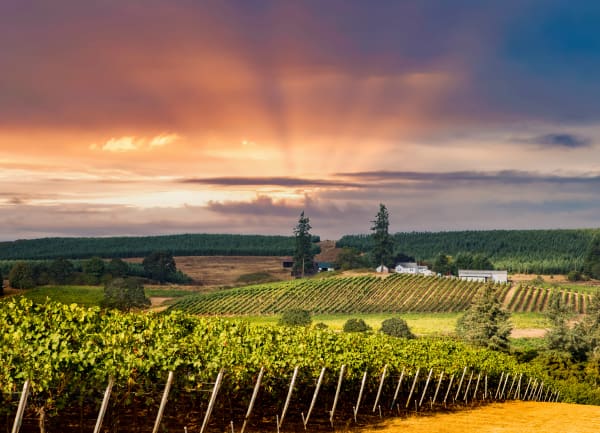
How do you finance a $3.95M, 80-acre commercial equestrian and cattle ranch with multiple residences in Nevada County, California?
On an 80-acre Grass Valley legacy ranch with three to four residences across two APNs, full equestrian infrastructure (16-stall barn, mare motel, covered and outdoor arenas, round pen, hot walker, cutting arena), cattle handling (cattle squeeze, cross-fenced irrigated pastures, two ponds), an orchard, and a 4-bay metal shop, you are out of standard residential lending entirely — and, given the commercial operations, out of jumbo-hybrid territory as the best fit. Conforming Conventional ($832,750 ceiling in Nevada County) is irrelevant. Standard residential jumbo functionally cannot close a multi-residence, multi-APN, dual-livestock-operation property of this scale. Our Hobby Farm Loans jumbo lends up to $5,000,000 and can reach 70% LTV on an owner-occupied 80-acre purchase (the 20+ acre cap) — the same leverage as our Ag loan — but it does not count ag income toward qualifying, and investor use drops to roughly 55% LTV at this loan size. The structural fit is our in-house true Ag loan options at up to 70% LTV ($2,765,000 first lien on a $3.95M purchase / $1,185,000 down), underwriting the property as an operating asset including all residences, equestrian and cattle infrastructure, water and irrigation, multi-parcel collateral, and projected boarding/breeding/cattle operating income, plus operating and equipment lines under the same lender.
Best for: California ranch buyers in Nevada, Placer, El Dorado, Amador, and Yuba counties looking at 50–200 acre legacy equestrian, cattle, or hybrid livestock estates over $3M, particularly buyers operating commercial breeding/training/boarding programs, running cattle, planning multi-generational compound use with rental income, or financing the property as an investor-owned legacy asset. This is the profile where leverage is equal but the structural answer is true Ag lending — kept in-house rather than referred out to a separate ag-only lender.
An 80-acre legacy ranch in Grass Valley with three to four residences, a 16-stall barn, a 6-stall mare motel, dual-purpose equestrian and cattle infrastructure, and a $3.95M list price is a different conversation than a hobby farm or even a high-end vineyard estate. It is a working operating asset — and at this scale the financing question stops being 'which jumbo product fits' and becomes 'when both products reach the same leverage, which one actually underwrites the operation.' A representative ~80-acre Nevada County ranch — a 3,862 sq ft main residence with four ensuite bedrooms and a resort pool, a separate 2 BR/1 BA caretaker home, a 3,045 sq ft third residence with an attached 1 BR/1 BA ADU, two APNs, a 16-stall barn with office, a 6-stall mare motel, covered and outdoor arenas, a covered round pen, hot walker, cutting arena, cattle squeeze, irrigated cross-fenced pastures, two ponds, an orchard, and a 4-bay metal shop — is a property whose value sits in its operating capability across multiple income streams: horse boarding, breeding, training, cattle running, residential rentals, and potentially corporate-retreat or family-compound use. Standard residential jumbo cannot underwrite this honestly; Hobby Farm Loans can match the 70% leverage but does not count the ranch's ag income toward qualifying; the structural answer is our in-house true Ag loan options. Here is the side-by-side analysis we run on Sierra Foothills ranch acquisitions of this scale. For background, see our vineyard property loans learn page, our how to finance a horse property learn page, and our agricultural loans learn page.
The Property Profile: An ~80-Acre Legacy Equestrian and Cattle Ranch in Nevada County
Grass Valley sits in Nevada County, about 17 miles from Auburn and 55 miles from Sacramento International Airport — close enough for corporate and Bay Area buyers to use the property as a primary or weekend residence, far enough that an 80-acre ranch trades at land prices closer to working ranch country than to wine-country amenity prices. The composite property we'll use throughout this case study runs to about 80 acres across two APNs. The land is set up for both horse and cattle operations: irrigated, cross-fenced pastures (suitable for rotational grazing), two ponds providing stock water and emergency fire-suppression supply, an orchard, and a 4-bay metal shop ideal for equipment storage, hay storage, or small-business use. The equestrian build-out is extensive: a 16-stall barn with an attached office (the kind of facility used for serious boarding, breeding, or training operations), a 6-stall mare motel (separate-stall outdoor housing typical of breeding facilities), a covered arena (year-round riding regardless of weather), a large outdoor arena, a covered round pen, a hot walker, and a dedicated cutting arena. The cattle infrastructure adds a cattle squeeze (a working chute for handling, vaccinating, branding, and pregnancy testing) integrated with the cross-fencing — meaning the property can run cattle commercially or as part of a diversified livestock operation alongside the horse program. The residential footprint is unusual: a main 3,862 sq ft home (four ensuite bedrooms, private office, expansive great room, resort-style pool with waterfall — the principal residence of the property), a separate 2 BR/1 BA home (intended as guest quarters, caretaker housing, or staff housing), and a third 3,045 sq ft residence on the second APN with three ensuite bedrooms, an office, and an attached 1 BR/1 BA ADU. Three legal residences plus an ADU — meaning the property can house an extended family, support multi-generational living, function as a corporate retreat, or run as an income property with multiple lease streams. Representative list price: $3,950,000. Property details have been generalized for privacy; the financing analysis below applies to any 50–200 acre Nevada, Placer, El Dorado, Amador, or Yuba County legacy equestrian/cattle ranch in roughly this price range.
Why This Scale of Property Is Out of Residential Lending Entirely
Three structural realities make standard residential lending — including standard residential jumbo — functionally unworkable on a property of this scale and use. First, multi-residence overlays. Most residential jumbo programs cap at one primary residence plus a permitted ADU, sometimes plus a guest house. This property has a main residence, a separate single-family caretaker home, a third single-family residence on a separate APN, and an attached ADU — three to four legal living units. Standard residential jumbo treats anything beyond '1 unit + ADU' as 2-4 unit multifamily (different rate sheet, lower LTV) or as 'commercial' (different product entirely). Second, multi-APN structure. The two APNs are operated as one ranch, but residential jumbo programs prefer a single legal description and either require lot-line adjustment (slow, expensive, may not be approvable in Nevada County's planning timeline) or carve the loan to one APN only (which collapses the collateral and the LTV math). Third, dual livestock operation. Standard residential jumbo overlays explicitly disqualify properties with active commercial livestock operations — meaning the working cattle infrastructure and the income-producing equestrian operation aren't 'features that need careful underwriting,' they're product-level disqualifiers. The right answer isn't to hide what the property is or to shoehorn it into a residential template — it's to use a product designed for what it actually is: a commercial-scale operating asset.
Hobby Farm Loans Can Reach the Same 70% — So Why Isn't It the Answer Here?
Our Hobby Farm Loans jumbo product is built for residences on rural and ag-zoned acreage, with a Hobby Farm tier that explicitly accepts ag zoning, ag income (allowed but not counted toward qualifying), and meaningful acreage with no acreage limit. On the Lincoln/Placer equestrian and Grass Valley vineyard case studies, Hobby Farm Loans was the primary product fit for owner-occupants at hobby scale. On a $3.95M ranch purchase, loan size is not the problem: the program lends up to $5,000,000, and the $2,765,000 loan needed sits in the 75% tier, capped at 70% by the 20+ acre rule — so an owner-occupant could reach the same 70% LTV ($2,765,000 / $1,185,000 down) as our Ag loan. The problem is underwriting fit. This property has three to four legal residences across two APNs, a commercial-scale cattle program, and boarding, breeding, and training income that a buyer will usually need counted toward qualifying — and Hobby Farm Loans does not count ag income. It also does not carry the operating and equipment lines a working ranch needs, and if the buyer is an investor, the program's LTV at this loan size drops to ~55% ($2,172,500). With leverage equal, the cleaner answer is to underwrite the property as the operating asset it is — under a product built for commercial-scale ranch operations. That product is our in-house true Ag loan options.
Why Multi-Residence Properties Need Multi-Residence Underwriting
The three-residence-plus-ADU structure on this property isn't a footnote — it's a load-bearing piece of the deal. Each unit creates value: the main residence is the buyer's principal residence in most acquisition scenarios; the separate 2 BR/1 BA home houses a caretaker, ranch manager, or trainer on-site (essential for any serious horse or cattle operation); the second-APN third residence houses extended family, staff, or generates rental income; the attached ADU adds an additional income or housing unit. Standard residential jumbo programs underwrite one residence and treat the rest as a problem to explain away. Our Ag loan options underwrite the entire residential footprint as part of the operating asset: the main residence as the borrower's residence (or, for an investor-buyer, as a leasable asset), the caretaker home as a labor-housing asset essential to the operation, the third residence and ADU as income-producing assets contributing to the property's debt-service capacity. The same physical property therefore qualifies for materially different loan amounts depending on which product is underwriting it — because each product is asking different questions about what the buyer actually owns. On a property with three to four legal living units, only ag underwriting captures the full picture.
Multi-APN Ranch Estates: How Two Parcels Get Financed Under One Loan
Many Sierra Foothills legacy ranches are assembled across multiple APNs — frequently for AG zoning preservation, water-rights flexibility, or generational family transfers (each generation deeded a parcel as inheritance, then re-assembled by a later acquirer). Standard residential jumbo programs prefer a single parcel and either require lot-line adjustment to merge parcels before closing or carve the loan to one parcel only. On an 80-acre dual-purpose ranch operating across two APNs as one functional unit, neither path is acceptable: the operation is one ranch, the value is in the unified property, and any program that fragments the collateral undervalues the deal. Our true Ag loan options finance multi-APN properties under a single loan when the parcels are contiguous, share common access, operate as a single economic unit, and are titled together at closing. Loans are documented with a master deed of trust covering all parcels, the appraisal values the unified property, and the borrower retains the operational and tax flexibility of the multi-APN structure. Hobby Farm Loans handles multi-parcel collateral the same way at smaller loan amounts — but on a $3.95M working ranch the binding constraint is underwriting the commercial operation and its income, not the multi-parcel mechanic.
Dual Livestock Operations: Equestrian and Cattle Income in One Underwriting Package
Most working ranches at this scale aren't single-purpose. The equestrian infrastructure (16-stall barn, mare motel, covered and outdoor arenas, round pen, hot walker, cutting arena) is designed for commercial-scale boarding, training, breeding, or competition use. The cattle infrastructure (cattle squeeze, cross-fenced irrigated pastures, two ponds for stock water) is designed for either a commercial cattle operation or for diversified livestock alongside the horse program. Both produce real income streams: boarding fees, training fees, breeding stud fees, foal sales, cattle sales, hay or pasture lease income — frequently with grant or cost-share programs (NRCS EQIP, county ag commissioner programs) layered in. Standard residential jumbo can't underwrite any of this. Hobby Farm Loans allows ag income (without counting it toward qualifying) but isn't a vehicle for underwriting commercial-scale livestock revenue. Our true Ag loan options underwrite the full P&L: revenue lines (boarding, training, breeding, cattle, hay), cost of goods sold (feed, vet, labor, fuel, breeding fees), capital expenditure (equipment, improvements), and projected operations under the new ownership's business plan. On a property explicitly designed for breeding, training, boarding, and cattle, only ag underwriting captures all of it.
Scenario 1: Conforming Conventional and Standard Residential Jumbo — Why Both Are Off the Table
Nevada County's 2026 conforming loan limit on a single-family residence is $832,750. On a $3.95M ranch purchase that ceiling is irrelevant — the buyer would need ~$3.12M in cash to fit a Conforming Conventional first lien under the limit, which is neither realistic nor the right capital allocation. The deal lands in jumbo or ag-loan territory by definition. Standard residential jumbo programs nominally extend up to $3M+ in loan amount on luxury properties, but on this property they fail at the structural level: the multi-residence configuration (3-4 legal living units) trips the program's '1 unit + ADU' overlay; the multi-APN structure forces a lot-line-adjustment or single-parcel carve neither of which works on a unified ranch operation; the active equestrian boarding/training/breeding income disqualifies under residential ag overlays; and the cattle operation is an explicit disqualifier under most residential jumbo guidelines. A buyer determined to force standard residential jumbo onto this property would face a low appraisal (the appraiser cannot credit the equestrian infrastructure, the cattle handling, the multi-residence value, or the operating-income streams), an underwriting decline once the ag-overlay flags fire, and a 60-90 day escrow that ends in the deal restructuring or dying. The product gap that our Hobby Farm Loans (Scenario 2) and our true Ag loan options (Scenario 3) fill is exactly this gap.
Scenario 2: Hobby Farm Loans — Same Leverage, Wrong Underwriting for a Working Ranch
Hobby Farm Loans (Hobby Farm tier) is the right primary product for owner-occupied ranch and equestrian properties run at hobby scale, where ag income is incidental to qualifying. On this $3.95M acquisition the leverage math works: the $2,765,000 loan falls in the program's 75% tier (loans up to $3M), and the 20+ acre cap brings it to 70%, matching our Ag loan at $1,185,000 down. What does not work is the underwriting. A buyer of this ranch typically needs the cattle, boarding, breeding, and training revenue counted toward debt-service capacity, needs the three to four residences and two APNs underwritten as one operating asset, and needs operating and equipment lines alongside the mortgage. Hobby Farm Loans allows ag income but does not count it toward qualifying, so the buyer would have to qualify on outside income alone. Investor buyers face a further step-down: ~55% LTV ($2,172,500 loan) at this loan size versus 70% under our Ag loan. The program offers 3/1, 5/1, and 7/1 ARMs and a 30-year fixed (40-year amortization on primary residences only), and some buyers with strong outside income and personal-use plans may still prefer it. But the buyer in this product's sweet spot — owner-occupied, hobby-scale — is typically the buyer of the Lincoln/Placer equestrian or Grass Valley vineyard properties, not the buyer of an 80-acre dual-livestock legacy ranch. At $3.95M, Hobby Farm Loans offers the same leverage with the wrong underwriting for a working ranch.
Scenario 3: Our True Ag Loan Options at up to 70% LTV — The Primary Product on Commercial-Scale Ranches
Our in-house true Ag loan options are the right product when the ranch is being financed as a commercial-scale operating asset rather than as a residence-with-acreage. Three buyer profiles route here on a property of this size, and on this Bear Hollow-style ranch all three are realistic. First, the commercial breeding/training/boarding operator — a buyer running or planning to run a commercial horse operation (16 stalls, mare motel, full arena complex), with documented revenue from boarding, training, breeding, foal sales, or competition, and equipment, labor, and operating-line needs alongside the real-estate financing. The full P&L gets underwritten, projected operations under the new ownership's business plan get modeled, and equipment and operating-line financing can be combined under the same lender relationship. Second, the cattle or hybrid-livestock operator — a buyer running cattle on the irrigated pastures (or planning to), potentially under a diversified-livestock model that includes the horse program. The cattle operation's revenue, herd-build cost, hay-and-feed P&L, and cross-fence pasture rotation all underwrite as part of the ranch's operating capacity. Third, the investor / legacy-acquisition buyer — someone purchasing the property as an income-producing legacy asset rather than as their primary residence: residences leased or executive-rental, equestrian operation leased to a professional trainer or boarding manager under a triple-net or revenue-share lease, cattle program operated under custom-grazing or lease arrangement. Hobby Farm Loans does allow investment property, but at this loan size the investor LTV is ~55% ($2,172,500) versus 70% under our Ag loan, and the lease and operating income would not count toward qualifying; the moment the buyer's plan is investor-driven, the structural fit is our Ag loan options. The structure on a $3.95M ranch at 70% LTV: a $2,765,000 first lien with $1,185,000 down — the same cash requirement as an owner-occupied Hobby Farm Loans purchase, but with the operation's income, residences, and APNs underwritten as one asset. We keep these loans in-house — meaning the customer never has to chase the ag side at a separate ag-only lender while we handle a residential piece. Same lender, one team, one underwriting package.
Side-by-Side: LTV, Down Payment, and Realistic Loan Outcomes Across the Three Products
Holding the purchase price constant at $3,950,000, here's how the three product paths compare on the variables that actually decide whether the deal closes. Conforming Conventional ($832,750 ceiling in Nevada County) is irrelevant — the buyer would need ~$3.12M in cash to fit the limit, which isn't a realistic capital allocation. Standard residential Jumbo is functionally unworkable: even at programs that nominally reach $3M+ in loan amount, the multi-residence, multi-APN, dual-livestock-operation profile of this property fails the structural overlays before pricing even matters. Our Hobby Farm Loans jumbo (Hobby Farm tier) reaches 70% LTV on an owner-occupied 80-acre purchase ($2,765,000 / $1,185,000 down; ~55% / $2,172,500 for an investor), but it does not count ag income toward qualifying and is built for hobby-scale use, not a three-to-four-residence commercial cattle and horse operation. Our true Ag loan options at up to 70% LTV deliver the same $2,765,000 loan with $1,185,000 down on the $3.95M purchase, underwriting the property as the operating asset it actually is — including all residences, equestrian and cattle infrastructure, multi-APN collateral, water and irrigation, and projected operating income. Bank-statement programs are off the table — they cap at 10 acres without exception. The structural choice on a property of this size and complexity isn't 'cheapest loan' or 'most leverage' — it's 'which product underwrites the operation,' and on commercial-scale legacy ranches the answer is true Ag lending.
Three Loan Paths on a $3.95M Nevada County Legacy Ranch
Representative ~80-acre Grass Valley/Nevada County ranch — three to four legal living units, two APNs, 16-stall barn with office, 6-stall mare motel, covered and outdoor arenas, round pen, hot walker, cutting arena, cattle squeeze, irrigated cross-fenced pastures, two ponds, orchard, 4-bay metal shop. Both Hobby Farm Loans and our Ag loan options reach 70% LTV here, but the multi-residence, multi-APN, commercial-operation profile puts this property squarely in true Ag-loan territory.
| Standard Residential Jumbo | Hobby Farm Loans | Our True Ag Loan Options | |
|---|---|---|---|
| Max Loan Amount | $3M+ nominally; functionally won't close on this property | Up to $5,000,000 (LTV steps down above $2M) | Up to $25,000,000 |
| Max LTV | 80% nominal — overlays disqualify in practice | 70% LTV (75% tier, capped by 20+ acre rule); ~55% investor | Up to 70% LTV |
| Loan on $3.95M Purchase | Generally won't close — multi-residence + multi-APN + livestock overlays | $2,765,000 (70% LTV) owner-occupied; ~$2,172,500 investor | $2,765,000 (70% LTV) |
| Down Payment on $3.95M | Often unworkable at any leverage | $1,185,000 (30%) owner-occupied | $1,185,000 (30%) |
| 3–4 Legal Living Units | Disqualifying overlay (1 unit + ADU) | Case-by-case; secondary-unit income not a primary qualifying source | Underwritten as part of operating asset |
| Multi-APN (2 parcels) | Lot-line adjustment or single-APN carve required | Allowed under single loan | Allowed under single loan |
| Commercial Equestrian Operations | Disqualifying overlay | Ag income allowed but not counted toward qualifying; not commercial scale | Full P&L underwritten |
| Cattle Operations | Disqualifying overlay | Not a vehicle for commercial cattle | Full P&L underwritten |
| Owner-Occupied vs. Investor | Owner-occupied or 2nd home | Primary, 2nd home, or investor (~55% LTV at this size) | Investor / rental use allowed |
| Equipment & Operating-Line Financing | Not available | Not available | Combined under same lender relationship |
| Self-Employed Documentation | Tax returns required | Tax-return analysis + 2 yrs business history | Holistic ag P&L review |
| Best For | Luxury single-residence properties without ag/livestock use | Owner-occupied, hobby-scale equestrian / vineyard estates | Commercial-scale ranches, investor-owned legacy ranches, multi-residence compounds, dual-livestock operations |
Investor and Family-Compound Buyers: How Multi-Stream Income Drives the Underwriting Math
The buyers actually closing on properties of this scale generally fall into two profiles: legacy / multi-generational family compound and investor / income-property. Both require multi-stream income modeling that only ag underwriting captures cleanly. Legacy / compound buyers typically occupy the main residence, house extended family or staff in the secondary and third residences, and operate the equestrian and (sometimes) cattle programs at scaled commercial or semi-commercial levels — generating measurable income but primarily in service of holding and operating the legacy asset. Investor buyers may occupy nothing on the property (residences leased, executive rental, or destination short-term rental on the main home; trainer or manager housed in caretaker home; equestrian operation under triple-net or revenue-share lease) — the entire property functioning as a yield asset. Both profiles benefit from underwriting that captures (1) residential lease income across the three-to-four-unit residential footprint; (2) equestrian operating revenue under a current or proposed boarding/training/breeding program; (3) cattle or hay income from the irrigated pastures; and (4) ancillary income (event/wedding rental of the property under a Nevada County use permit, equipment-storage lease in the 4-bay shop, orchard or hay sales). Our true Ag loan options underwrite all four streams as part of the property's debt-service capacity. Standard residential and even hybrid-jumbo products cannot.
Why Sacramento and Bay Area Lenders Struggle With Sierra Foothills Working Ranches
Most California ag-and-equestrian lending capacity at this scale either sits with national jumbo banks (whose product menus stop at residential and don't extend to true Ag) or with ag-only lenders (who run pure Ag loans but not residential-side products). The buyer of an 80-acre Nevada County legacy ranch typically needs both — and ends up running parallel transactions with two different lenders, two different appraisers, and two different timelines. Or they get pushed into a residential jumbo that won't close, restart at an ag-only lender, and lose 60-90 days in escrow. The right lender for this market needs three things: (1) a Hobby Farm Loans-style hybrid jumbo product and in-house true Ag loan options — so the property can be underwritten under a single product fit to its actual scale and use, without two lenders and two transactions; (2) an ag-savvy appraisal panel for Nevada, Placer, El Dorado, Amador, and Yuba counties, with specific competence on equestrian facilities, cattle operations, irrigated pasture, and multi-residence ranch valuations; and (3) familiarity with multi-APN and AG-zoned underwriting mechanics so the loan terms align with the property's structure rather than fighting it. Lumen Mortgage is licensed in California and quotes Conventional, Hobby Farm Loans, and our true Ag loan options side-by-side on Sierra Foothills equestrian, vineyard, and ranch estates — the customer sees the structural choice rather than getting routed to a single product because that's the only one a given lender writes.
Decision Tree: Which Loan Fits Which Buyer Profile on a Legacy-Scale Ranch
Use this six-step sequence on any Sierra Foothills working-ranch financing decision over roughly $2.5M in purchase price: (1) Leverage check — what LTV does each product allow? Hobby Farm Loans lends up to $5,000,000, with LTV set by the lower of the loan-size tier and the acreage cap (70% at 20+ acres); on an owner-occupied 80-acre ranch at this price it reaches the same 70% as our Ag loan. When leverage is equal, the decision turns on the remaining checks. (2) Multi-residence check — does the property have three or more legal living units (main residence + caretaker + third residence + ADU)? Standard residential jumbo overlays disqualify most multi-residence configurations; our Ag loan options underwrite the residential footprint as part of the operating asset. (3) Multi-APN check — is the property assembled across two or more APNs operated as one ranch? Our Ag loan options finance multi-APN collateral under one loan; standard residential jumbo typically requires lot-line adjustment or single-APN carve. (4) Operation-scale check — is this a hobby/personal-use property or a commercial-scale operating asset (commercial breeding, training, boarding, cattle, dairy, or other livestock at scale)? Commercial scale routes to true Ag underwriting regardless of headline LTV trade-off. (5) Occupancy check — owner-occupied legacy/compound, or pure investor / income property? Investor profile routes to true Ag underwriting; Hobby Farm Loans allows investment property but at ~55% LTV at this loan size, without counting ag or lease income toward qualifying. (6) Cash-position check — at 70% LTV on our Ag loan options, does the buyer have the down payment ($1,185,000 on a $3.95M purchase)? If not, the conversation moves to partner buyers, or repositioning the acquisition. Walk those six in order and the right product picks itself. For owner-occupied properties at smaller scale, see our Lincoln/Placer County equestrian estate case study (19 acres, $1.5M, Hobby Farm Loans primary) and our Grass Valley vineyard estate case study (30 acres, $2.29M, Hobby Farm Loans vs. Ag loan decision turning on use-permit and commercial-scale plans).
Model Your Farm Loan
Agricultural Loan Calculator
Agricultural loans work differently from residential mortgages — larger required down payments, sometimes shorter amortization periods, and monthly carrying costs that need to work against seasonal income rather than a steady paycheck. Before you make an offer on farmland or a rural property, knowing your payment scenario shapes the entire negotiation.
The ag loan calculator lets you model purchase price against the 25–35% down payments typical of farm lending, compare 20-, 25-, and 30-year amortization schedules, and see how rate variations move your monthly carrying cost. For a cash-flowing operation, that monthly number is as important as the land price itself.
Down payment scenarios
Model your monthly payment at 25%, 30%, and 35% down — the range most ag lenders require on farm purchases.
Amortization comparison
See how 20-yr vs. 25-yr vs. 30-yr amortization changes your monthly payment and total interest paid over time.
Rate sensitivity
Small rate differences compound significantly over long amortizations on large balances. See the real magnitude.
Free · No login · No credit pull required
CPA / Tax Pro Referral
Need a CPA who actually knows Schedule F?
Commercial ranch and ag operations live or die on tax structuring — Schedule F vs. Schedule E, Section 179 on equipment, conservation easements, depreciation recapture on improvements. We work with CPAs who handle real working-ranch returns in Nevada and Placer County, not generic small-business preparers. Ask us for a personal intro.
No directory. No paid placements. No RESPA-restricted referral fees. We've worked alongside these pros on real Oregon and California deals — we'll make a personal email introduction so you can interview them yourself.
Or email us directly:
Frequently Asked Questions
Can a residential mortgage finance a commercial-scale equestrian and cattle ranch in California?
Does Hobby Farm Loans work on a $3.95M legacy ranch?
What LTV can our true Ag loan options reach on a commercial-scale ranch?
How are multi-residence ranch properties underwritten under our Ag loan options?
Can two APNs be financed under one loan on a unified ranch?
Does our underwriting credit cattle and equestrian operating income on a ranch loan?
Is bank-statement financing an option on a property of this size?
Why keep ag and residential lending under one roof rather than running two transactions?
Looking for Ag Financing?
Farm purchase, ranch, raw land, operating lines, and specialty crop loans — structured around how your operation actually works.
Bottom Line
An 80-acre legacy ranch in Grass Valley with three to four residences, full equestrian and cattle infrastructure, two APNs, irrigated cross-fenced pastures, two ponds, an orchard, and a 4-bay metal shop is not a residential transaction with horse property attached — it is a commercial-scale operating asset whose value sits in its capacity to generate boarding, training, breeding, cattle, lease, and rental income across a unified property. A $3,950,000 list price on a property like this is honest if the appraisal is honest, and the appraisal is only honest if the loan product is built to underwrite what the property actually is. Conforming Conventional is irrelevant at this scale. Standard residential jumbo cannot close a multi-residence, multi-APN, dual-livestock-operation property of this size. Our Hobby Farm Loans jumbo can reach the same 70% LTV on an owner-occupied purchase, but it does not count ag income toward qualifying and is built for hobby-scale use, not a commercial cattle and horse operation with three to four residences across two APNs. The structural fit on a $3.95M legacy ranch is our in-house true Ag loan options at up to 70% LTV — a $2,765,000 first lien with $1,185,000 down on the representative case, underwriting the entire property as the operating asset it is: all residences, all equestrian and cattle infrastructure, multi-APN collateral under one loan, water and irrigation, and projected operating income across boarding, training, breeding, cattle, and rental streams. We keep this work in-house — meaning the customer never has to chase the ag side at a separate ag-only lender while a different lender handles a residential piece. Same lender, one team, one underwriting package. If you're financing an equestrian, cattle, or hybrid livestock ranch anywhere in Nevada, Placer, El Dorado, Amador, or Yuba counties at $2.5M and up, that's the kind of analysis we walk through before any quote — because at this price point the rate is the easy part. For the foundational primer on the products themselves, our agricultural loans learn page, how to finance a horse property learn page, and vineyard property loans learn page cover the underlying mechanics. For the regional Sierra Foothills tri-county overview covering Placer, Nevada, and El Dorado — Williamson Act, AE/AG zoning, NID/PCWA/EID water, Cal Fire SRA — see our Sierra Foothills agricultural loans pillar. And to compare programs on income-producing horse operations specifically, see our commercial horse property loans page. For Grass Valley, Nevada City and the rest of Nevada County, see our Gold Country mortgage lender page.